
ISO 55001 maintenance refers to maintenance practices integrated into an asset management system compliant with ISO 55001:2024, the edition in force since July 2024. This standard does not concern maintenance exclusively: it applies to all types of assets and organizations. In industry, maintenance becomes a strategic function serving value across the asset life cycle, rather than a mere response to breakdowns. Without a structured framework, an organization may be more exposed to hidden costs, operational risks, and traceability gaps.
If you want to understand how to concretely structure your maintenance operations within this framework, the dedicated Picomto maintenance page offers a useful starting point.
This article covers the pillars of the standard, its requirements applicable to maintenance, its potential benefits, and the role of digital tools in its implementation.
| What is the ISO 55001 standard? |
|---|
| ISO 55001:2024 defines the requirements for an asset management system. It applies to all types of assets; in industry, this notably concerns machinery, equipment, installations, and infrastructure. Maintenance is a lever for performance, risk control, and value creation within it, but ISO 55001 is not a maintenance standard. Sources: ISO 55001:2024 — ISO and NF ISO 55001 — AFNOR. |
| Key data — ISO 55001 maintenance |
|---|
|
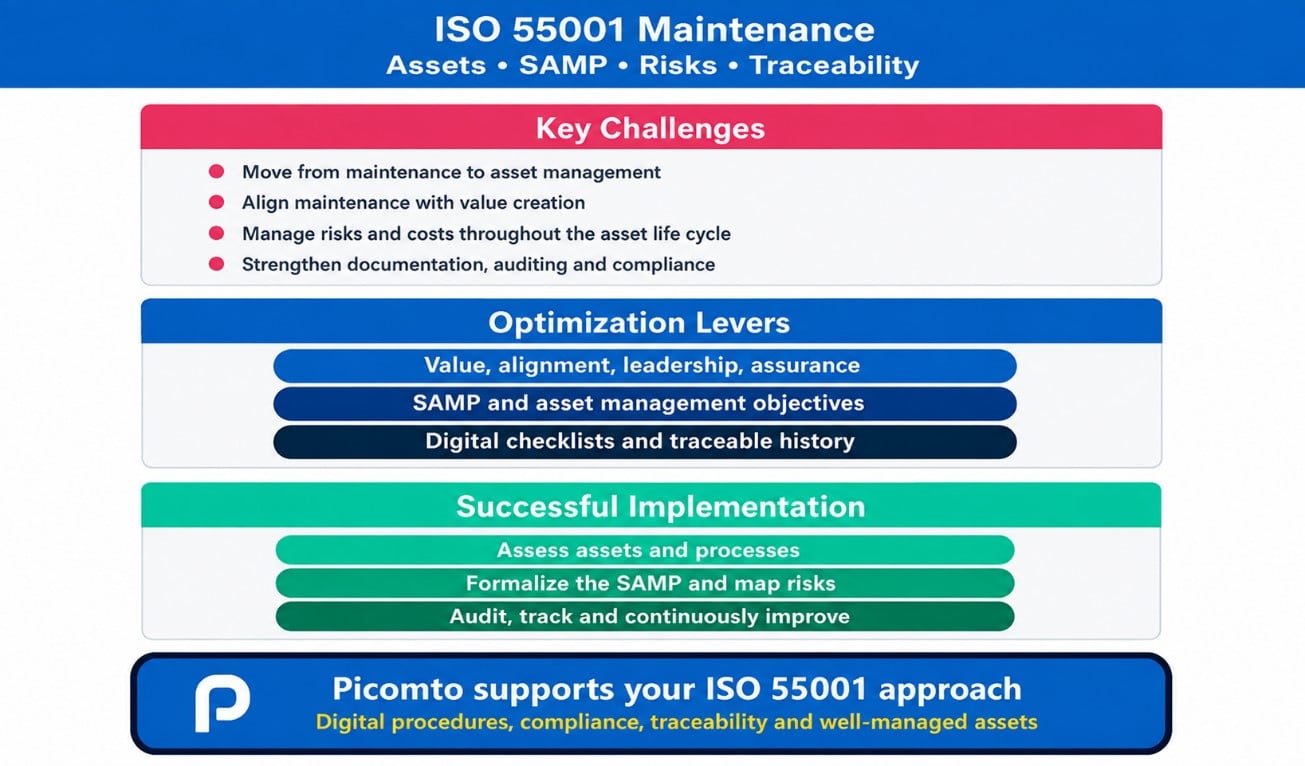
Key takeaways on ISO 55001 maintenance :
- Maintenance becomes strategic. Decisions are linked to asset value, risk, and performance.
- The SAMP structures asset management. It connects asset management objectives to the organization’s overall direction.
- The standard is accessible to organizations of all sizes. SMEs, mid-sized companies, and large groups can all apply it.
- Data is central. The 2024 edition strengthens requirements relating to data, information, and knowledge.
- Digital tools facilitate implementation. Checklists and digital instructions can support standardization but do not, on their own, guarantee compliance.
- Risks and opportunities are distinguished. The 2024 edition treats them separately to improve decision-making. Operational risk management is central. Criticality and risk analysis guides preventive and predictive maintenance priorities.
CEO and co-founder of Picomto, with 20 years of experience in industrial management
LinkedIn
1. What does ISO 55001 concretely change for your maintenance function?
For maintenance managers seeking to understand « what is the ISO 55001 standard? », the main challenge lies first in distinguishing asset management from simple equipment upkeep.
ISO 55001:2024 defines the requirements for an asset management system, thereby driving a major conceptual shift: moving from « maintaining equipment » to « managing assets within a value-driven logic. »
For industrial maintenance, this shift redefines decision criteria, performance indicators, and the place of the maintenance department within the organization. Interventions are no longer considered in isolation: they are linked to business objectives, risks, costs, expected performance, and the asset life cycle.
1.1. What is the difference between a traditional approach and ISO 55001 asset management?
Traditional maintenance responds to breakdowns or schedules periodic interventions. Asset management under ISO 55001:2024 broadens decision-making to encompass the life cycle, risks, opportunities, resources, and the contribution of assets to organizational objectives.
The asset management system therefore encompasses maintenance as one essential function among others.
1.2. Does the ISO 55001 standard also apply to SMEs and mid-sized companies?
Yes. ISO 55001:2024 applies to all types and sizes of organizations. An industrial SME can therefore structure its asset management system according to the same general requirements as a large group, with resources proportionate to its context.
1.3. What is the link between Asset Management and maintenance according to ISO 55001?
Maintenance is a key function serving asset management, without constituting the whole of it. The asset management system links strategy, objectives, resources, risks, life cycle, and performance. Maintenance contributes to this by preserving equipment availability and feeding decision-making through field data.

2. Which ISO 55001 pillars transform your maintenance strategy?
AFNOR Compétences presents four conceptual pillars: value, alignment, leadership, and assurance. Each translates into maintenance practices.
2.1. What are the four ISO 55001 pillars applicable to maintenance?
ISO 55001 Pillar
| ISO 55001 Pillar | Maintenance Translation |
|---|---|
| Value | Each intervention is prioritized according to its contribution to asset performance and value |
| Alignment | Maintenance objectives are linked to organizational objectives |
| Leadership | Management supports responsibilities, resources, and priorities |
| Assurance | Processes, data, and results are monitored, audited, and improved |
2.2. The Strategic Asset Management Plan (SAMP): how does it structure your maintenance?
ISO 55001:2024 strengthens the role of the SAMP and positions it as a key element of planning. It translates the organization’s direction into asset management objectives and helps define decision criteria, resources, and priorities.
For maintenance, it enables criticality, intervention plans, competencies, costs, risks, and expected performance levels to be linked together. Source: ISO/TC 251 — SAMP in ISO 55001:2024.
2.3. What concrete requirements does ISO 55001 impose on the maintenance department?
ISO 55001 does not prescribe a universal list of maintenance tools. For a maintenance department, its requirements translate notably into controlled documented information, data suited to decision-making, competencies, tracked objectives, performance evaluations, internal audits, and continual improvement. The 2024 edition also strengthens data, information, knowledge, and predictive actions.
Intervention histories, digital checklists, and paperless operating procedures can support these needs, but remain means of implementation rather than technologies mandated by the standard.
3. What are the concrete benefits of ISO 55001 for your maintenance function?
A properly implemented ISO 55001 approach can improve reliability, cost and risk control, and external credibility. These benefits depend on context, decisions made, and the organization’s maturity level.
3.1. How does ISO 55001 improve equipment reliability and availability?
The life-cycle perspective favors consistent intervention planning. The 2024 edition strengthens life-cycle management and introduces predictive action into the asset management system.
By prioritizing decisions according to objectives, risks, and expected value, the organization can concentrate its resources on the most critical assets and better prevent certain unplanned failures. Source: ISO/TC 251 — key 2024 developments.
3.2. What cost and risk-control gains can be expected from ISO 55001?
Cost optimization can result from better resource allocation, life-cycle trade-offs, and a reduction in corrective interventions. In maintenance, criticality analysis and intervention data help make priorities more objective. Gains nonetheless depend on the asset base and initial maturity level.
3.3. How does ISO 55001 certification strengthen your maintenance department’s credibility?
AFNOR Certification presents ISO 55001 as a means of demonstrating an organization’s capacity to sustainably manage its assets.
Guy Marguet, of Geneva Airport, explains that certification strengthens credibility among stakeholders such as airlines. In demanding sectors, it can serve as an additional signal of trust.
Discover how industrial companies structure their maintenance management in the dedicated Picomto webinar!
4. How do you implement ISO 55001 in your maintenance department?
Implementing ISO 55001 follows a structured progression. Its scope and resources must be proportionate to the organization’s assets, risks, and objectives.

4.1. What are the key steps to deploying ISO 55001 in a maintenance department?
- Diagnosis of the current state — mapping assets, processes, data, and gaps.
- Defining the SAMP — linking asset management objectives to organizational direction.
- Mapping risks and opportunities — prioritizing assets according to criticality and life cycle.
- Establishing documented processes — defining responsibilities, interventions, and required data.
- Internal audit — measuring performance and verifying that the system functions properly.
- Certification — having the system evaluated by a competent certification body if the organization wishes to be certified.
4.2. How do you digitalize maintenance procedures to meet ISO 55001 requirements?
Digitalization is not an ISO 55001 requirement, but it can facilitate document control, data collection, and knowledge sharing. Digital instructions, checklists, and field forms make it possible to attach data to an operation and disseminate up-to-date versions.
Picomto notably enables the distribution of version-controlled instructions, the collection of data during operations, and the connection of certain workflows to an existing CMMS. These functions support the approach without, on their own, constituting proof of compliance. Functional source: Picomto Maintenance solution.
Explore Picomto’s digital checklist features to structure your maintenance interventions in line with ISO 55001 traceability requirements.
4.3. What role does training play in implementing ISO 55001?
Competency and knowledge are important within the asset management system. The 2024 edition notably introduces a dedicated section on knowledge. Technicians must have the skills required for their assigned activities and understand the relevant objectives.
Digital instructions accessible at the workstation can facilitate knowledge transfer and consistent application of procedures. Source: ISO/TC 251 — data and knowledge.
Conclusion
ISO 55001 maintenance is neither a new maintenance method nor a standalone regulatory constraint. It corresponds to the integration of maintenance into an asset management system compliant with ISO 55001:2024, following a logic of value, risk, life cycle, and continual improvement.
Its pillars — value, alignment, leadership, assurance — provide an operational reading of asset management. The 2024 edition also strengthens the SAMP, risks and opportunities, data, knowledge, life cycle, and predictive action. Digital procedures and checklists can support this approach without replacing the management system.
Ready to structure your maintenance processes within an ISO 55001 logic? Discover how Picomto supports your teams — and request a demonstration tailored to your context.
FAQ
What is the ISO 55001 standard?
ISO 55001:2024 defines the requirements for an asset management system. It applies to all types of assets and to organizations of all types and sizes. It notably aims at value creation across the life cycle, achievement of asset management objectives, and continual improvement. Source: ISO 55001:2024.
What is the difference between ISO 55000 and ISO 55001?
ISO 55000:2024 provides the vocabulary, overview, and principles of asset management. ISO 55001:2024 defines the requirements used for certification. ISO 55002:2018 provides implementation guidelines; a new edition is still under development in 2026.
What is the ISO 55001 model?
ISO 55001 follows the structure of a management system standard: context, leadership, planning, support, operation, performance evaluation, and improvement. AFNOR Compétences also presents four conceptual pillars — value, alignment, leadership, and assurance. The 2024 edition notably strengthens the SAMP, decision-making, data, and predictive action.
Is the ISO 50001 standard mandatory?
No. ISO 55001 is a voluntary standard and does not, on its own, create a general legal obligation for certification. An organization may nonetheless choose to apply it, while certain contracts, sectors, or tenders may value or require certification. Requirements specific to each context should be verified.
What is the difference between ISO 14001 and ISO 50001?
ISO 14001 concerns environmental management. ISO 55001 concerns the asset management system and the value produced by assets across their life cycle. The two standards are distinct but can coexist within an integrated management system.
Key takeaways:
- ISO 55001 maintenance is integrated within an asset management system.
- ISO 55001:2024 is the edition currently in force.
- The SAMP links strategy, objectives, and asset management.
- The 2024 edition strengthens data, knowledge, risks, opportunities, and predictive action.
- Digitalization facilitates traceability but does not guarantee compliance.
Certification can strengthen external credibility.











Laisser un commentaire