
A maintenance solution designed to avoid production shutdowns aims to preserve the continuity of the industrial flow as much as possible through equipment monitoring, failure anticipation, and appropriately organized interventions. But can a machine really be worked on without interrupting its operation? In France, the general principle remains that interventions must be carried out while equipment is stopped whenever moving parts present a risk. Certain operations may nevertheless require equipment to remain running when it is technically impossible to carry them out at a standstill, subject to strict safety measures. Condition-based maintenance, predictive maintenance, the Sécurafim approach, IoT sensors, and digitalized work instructions then make it possible to build an appropriate strategy. This article details the regulatory framework, the technical solutions available, the benefits, and the concrete steps for initiating this transition in your plant.
If you want to understand how to digitalize your maintenance procedures to reduce downtime, the Picomto webinar on maintenance management offers a directly applicable operational introduction
| What Is Maintenance Without Production Shutdown? |
|---|
| Maintenance without production shutdown does not necessarily mean repairing a machine while it is running. It covers several situations: monitoring the condition of equipment while it is operating, online maintenance when the operation does not affect performance, working on a properly isolated part of an installation, or, in strictly regulated situations, an operation requiring certain energy sources to remain active. This approach rests on three pillars in particular: continuous condition monitoring of equipment, governed by ISO 17359:2018; safety lockout procedures adapted to the risks involved; and the digitalization of operating procedures to guide technicians and provide traceability of interventions. |
| Key Data — Maintenance Without Production Shutdown: |
|---|
|
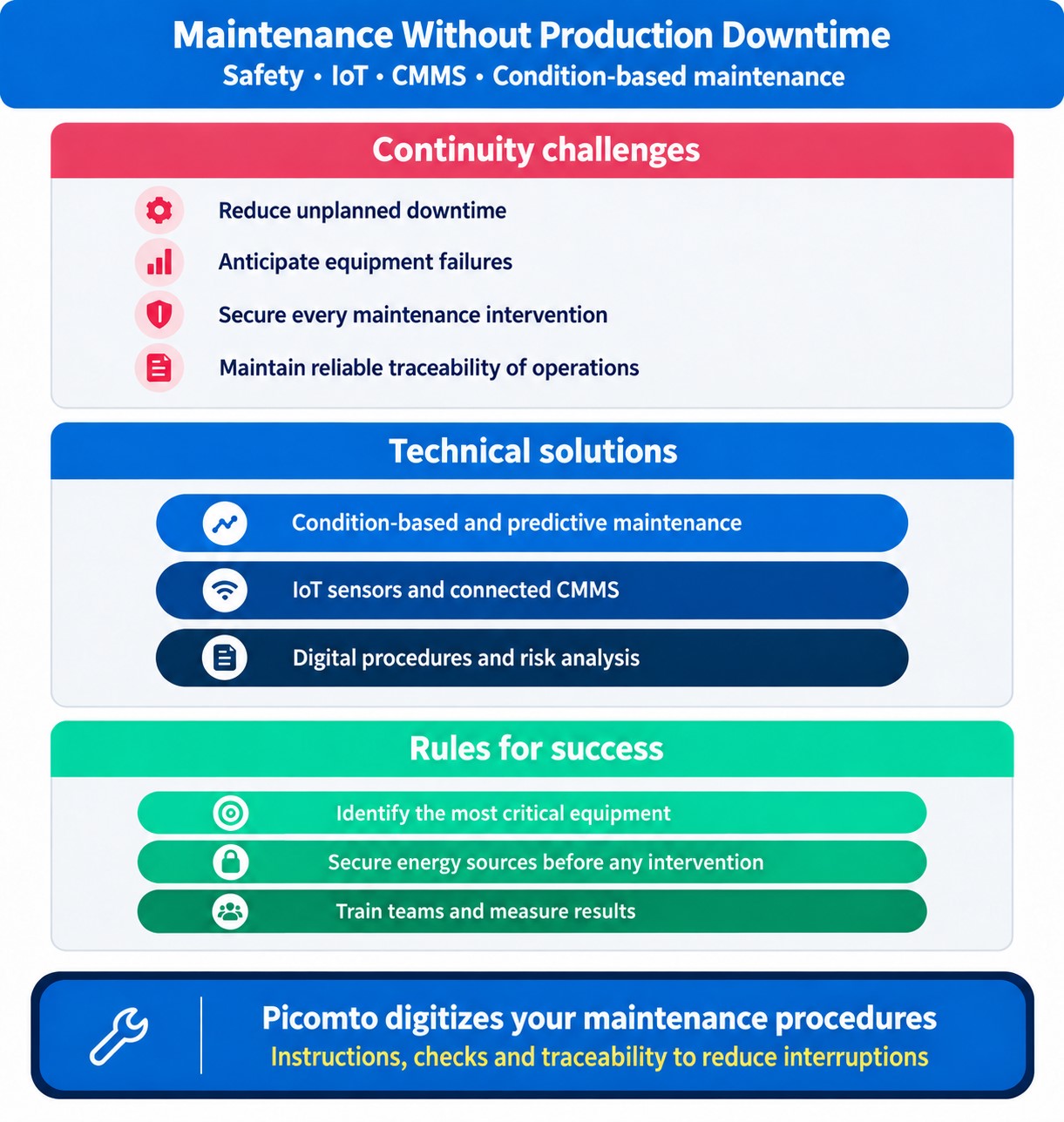
Key Takeaways on Maintenance Without Production Shutdown:
- Monitoring without stopping does not mean repairing without stopping. Condition-based and predictive maintenance are primarily useful for detecting drift and better planning interventions.
- Working on running equipment is strictly regulated. Article R4323-15 does not constitute a general authorization to intervene on a machine while it is running.
- Operator safety remains the priority. Any intervention requires a prior risk analysis and appropriate prevention measures.
- IoT sensors and connected CMMS are important technological building blocks. They facilitate monitoring, data collection, and the organization of operations.
- Digitalizing operating procedures promotes standardization. It improves access to procedures, their updating, and traceability.
- Continuity of service fits into an overall asset management strategy. ISO 55000:2024 links asset management to the organization’s objectives, value creation, and risk control. Consult ISO 55000:2024.
Emmanuel Toulisse, CEO of Picomto | LinkedIn
1. Why Has a Maintenance Solution Without Production Shutdown Become an Industrial Imperative?
Unplanned shutdowns are among the events most likely to severely degrade the performance of an industrial line. Beyond the loss of capacity, they can cause delays, scrap, schedule disruption, emergency interventions, and unplanned mobilization of teams.
Understanding these mechanisms is the first step in determining where a condition-based maintenance, predictive maintenance, or continuous monitoring strategy can create the most value.

1.1. What Is the Real Cost of an Unplanned Production Shutdown for a Plant?
An unplanned shutdown simultaneously affects several performance indicators: downtime, or unavailability time; MTBF (Mean Time Between Failures); and MTTR (Mean Time To Repair).
These indicators feed directly into the analysis of equipment availability and effectiveness, notably through OEE (Overall Equipment Effectiveness).
The real cost of a shutdown varies significantly depending on the sector, the criticality of the equipment, the duration of the interruption, production losses, and the consequences on upstream and downstream operations. It is therefore preferable to avoid generic estimates and to assess consequences based on data specific to each industrial site.
1.2. Where Do Traditional Maintenance Models Reach Their Limits in Modern Industry?
- Corrective maintenance, carried out after a failure, exposes the plant to interruptions that are sometimes difficult to predict.
- Systematic preventive maintenance, carried out at predefined intervals, makes it possible to plan operations, but can also lead to interventions on equipment whose condition does not yet justify the operation.
- Condition-based maintenance, by contrast, relies on assessing the actual physical condition of the system.
- Predictive maintenance, often referred to as predictive maintenance in industrial parlance, uses repeated analysis of parameters to estimate the progression of degradation.
These approaches make it possible to better target the timing of an intervention and to reduce certain systematic operations. However, they do not mean that a repair can necessarily be carried out while the equipment is running.
1.3. Which Industrial Sectors Are Most Exposed to Shutdown Costs?
Continuous-process industries, highly automated industries, or those dependent on critical equipment are particularly sensitive to interruptions: pharmaceuticals, chemicals, energy, cosmetics, food processing, and aerospace.
Some of these sectors are also subject to stricter documentation, quality, or traceability requirements. Their exact nature, however, depends on the regulations and reference frameworks applicable to each activity.
Digitalizing work instructions and collecting field data can then help improve standardization, traceability, and intervention preparation.
2. Legal and Safety Framework: Can Production Really Continue Without Stopping?
Before deploying a technical solution, it is essential to distinguish between monitoring running equipment and physically intervening in an area presenting a hazard.
French regulations clearly establish that intervening while equipment is running is not the general rule when transmissions, mechanisms, or moving parts are capable of presenting a risk.
2.1. What Does French Regulation Say About Maintenance While Running (Article R4323-15)?
Article R4323-15 of the Labour Code provides that when transmissions, mechanisms, or equipment with moving parts capable of presenting a risk are running, workers may not carry out various maintenance operations.
Before work is carried out at a standstill, measures must be taken to prevent any unexpected restart.
When certain work is technically impossible to carry out at a standstill, specific provisions must be put in place to prevent access to hazardous areas or to implement operating conditions, work organization, or operating procedures that preserve safety.
The employer must draft a specific instruction. In this case, the work may only be carried out by workers assigned to the maintenance and dismantling of the equipment.
The exception therefore exists, but it remains strictly conditioned.
Official text of Article R4323-15 — Légifrance
2.2. What Is Lockout/Tagout (LOTO) and Why Is It Central?
Lockout aims to place and maintain equipment in a safe state during an intervention, notably by controlling the various energy sources capable of exposing the technician to a hazard.
INRS guide ED 6109 on lockout and unlocking procedures emphasizes the importance of establishing a procedure adapted to the situation and to the energy sources involved.
On a line comprising several sub-assemblies, whether part of the installation can remain running depends notably on its architecture, the independence of the zones, the energy sources, the means of separation, and the risk analysis.
It is therefore preferable not to present a “partial LOTO” as a generic solution applicable to all installations.
2.3. How Should a Risk Analysis Be Structured Before Any Online Intervention?
A prior analysis must notably identify the energy sources present — electrical, hydraulic, pneumatic, mechanical, or thermal — the hazardous areas, the operating conditions, and the potential exposure of the technicians involved.
When certain energy sources must exceptionally remain active, the conditions set out by the Labour Code must be incorporated into internal procedures and employer instructions.
Formalizing this information in digital instructions accessible on smartphone or tablet can facilitate the standardization of operations and traceability.
Picomto’s operating procedures make it possible to centralize instructions, checks, validations, and content intended for field teams.
3. What Are the Technical Solutions for Continuous, Safe Maintenance?
Monitoring technologies and digital tools now make it possible to better detect drift, prepare interventions, and track their execution.
A coherent strategy generally combines machine data, maintenance rules, risk analysis, and instructions intended for field teams.

3.1. Condition-Based and Predictive Maintenance: What Are the Foundations of Non-Interruption?
According to the terminology from NF EN 13306:
- Condition-based maintenance relies on assessing the actual physical condition of the system.
- Predictive maintenance, often referred to as predictive maintenance, relies on a forecast of degradation obtained from repeated analysis of significant parameters.
These approaches primarily make it possible to monitor equipment while it is running and to determine, with greater precision, the appropriate time to intervene.
NF EN 13306 also distinguishes online maintenance, carried out while the system is running without affecting its performance.
This concept must be differentiated from a repair requiring access to a hazardous area.
| Approach | Trigger | Main Advantage | Limitation |
|---|---|---|---|
| Corrective | Confirmed failure | No preventive cost | Unpredictable shutdown |
| Systematic preventive | Predefined schedule or usage | Plannable intervention | Intervention sometimes premature |
| Condition-based | Actual equipment condition | Better-targeted intervention | Requires reliable data |
| Predictive | Trend analysis | Anticipation of degradation | Investment in data and analysis tools |
3.2. What Technologies — IoT Sensors, Connected CMMS — Make This Possible?
IoT sensors can track parameters such as vibration, temperature, current, or pressure and transmit this information to monitoring systems.
A connected CMMS can centralize events, histories, alerts, and interventions. The IIoT (Industrial Internet of Things), for its part, facilitates the flow of data between equipment and digital systems.
ISO 17359:2018 provides the general guidelines to consider when setting up a machine condition-monitoring program. It remains the currently published ISO version.
Depending on the equipment, vibration analysis, thermal monitoring, electrical analysis, or statistical models can complement this monitoring.
Their role is to improve knowledge of asset condition and the anticipation of failures, not to automatically make it possible to intervene while equipment is running.
3.3. The Sécurafim Approach: How Can an Intervention Be Secured in the Presence of Energy Sources?
The Sécurafim approach, developed jointly by AFIM and INRS, focuses in particular on identifying the energy sources and fluids present on equipment, the methods for securing it, lockout points, and safety devices.
It thus provides methodological and visual support for controlling energy sources during maintenance operations.
Digitalizing this information can supplement the approach by making instructions available in the field, facilitating their updating, and keeping a record of validations.

4. Where to Start When Deploying a Maintenance-Without-Shutdown Solution in Your Plant?
Moving toward maintenance that is more condition-based and data-driven requires a gradual approach.
The goal is not to systematically eliminate all shutdowns: it is to avoid unnecessary interruptions, detect drift earlier, and organize interventions at the most appropriate time, while maintaining an adequate level of safety.
4.1. What Are the Priority Steps for Deploying This Approach?
An effective roadmap can be built around five steps:
- Audit the current condition of equipment, maintenance practices, and recurring incidents.
- Identify critical equipment for which a failure would have the most significant operational consequences.
- Choose appropriate monitoring resources: sensors, data collection, CMMS, or tracking tools.
- Digitalize intervention procedures to make instructions available, controlled, and traceable.
- Train teams on the tools, procedures, risks, and validation rules involved.
For some companies, digitalizing operating procedures represents an accessible first step, as it can be undertaken without immediately instrumenting the entire machine fleet. It must nevertheless remain integrated into an overall maintenance strategy.
4.2. What Are the Main Challenges to Anticipate During the Transition?
The most common obstacles concern field teams’ adoption of new tools, the cost of instrumentation, the quality of collected data, system interoperability, and training.
A gradual approach, starting with the most critical equipment, makes it possible to test methods and measure results before wider rollout.
It is also important to define consistent indicators: number of failures, downtime, MTTR, availability, procedure compliance, or maintenance plan completion rate.
4.3. How Can Field Teams Be Trained and Brought On Board With New Procedures?
The human factor remains a decisive element in any data-driven maintenance strategy.
Training operators on digital tools, understanding procedures, and validating competencies must accompany the technical transformation.
A digital platform for managing operating procedures can centralize instructions, offer multimedia content, and support skills development.
Picomto notably offers a resource dedicated to digitalizing operator training. Discover the webinar on digitalizing training.
The goal is not solely to deploy a tool: it is to make the right information available at the right time and to bring field practices closer to validated procedures.
Conclusion
Maintenance without production shutdown is not a utopia reserved for large industries. It is a structured, standardized, and technologically accessible approach, resting on three complementary pillars: a clear legal framework (Article R4323-15), proven methods (predictive maintenance, the Sécurafim approach), and appropriate digital tools (IoT sensors, CMMS, digitalized instructions). ISO 55000:2024 reminds us that production continuity is a strategic asset management objective, not merely a technical constraint. Digitalizing intervention procedures is the common foundation for all these steps: it promotes compliance, reduces variations in practice, and facilitates teams’ skills development.
Want to digitalize your maintenance procedures and reduce your unplanned shutdowns? Discover how Picomto supports industrial companies in this process and request your demonstration.
FAQ
What technologies make it possible to carry out maintenance while keeping the production line running?
IoT sensors, vibration or thermal monitoring, condition-monitoring tools, and a connected CMMS make it possible to track the condition of many pieces of equipment without stopping them. Condition-based and predictive maintenance then help determine the appropriate time to intervene. However, a physical repair may require a shutdown and safety lockout depending on the risks present.
What are the concrete benefits of adopting a maintenance-without-shutdown solution?
This approach makes it possible to detect certain drift earlier, avoid unnecessary systematic interventions, better schedule necessary shutdowns, and improve equipment availability. Results, however, depend on asset criticality, data quality, and the maturity of the maintenance organization.
What types of companies are concerned with maintenance without production shutdown?
Continuous-process industries or those highly dependent on equipment availability are particularly concerned: chemicals, energy, pharmaceuticals, aerospace, cosmetics, food processing, and manufacturing. The strategy must nevertheless be adapted to the risks, equipment, and requirements applicable to each activity.
What risks remain, and what best practices help limit them?
Risks notably include exposure to hazardous energy sources, insufficient procedures, human error, or a misinterpretation of the concept of “maintenance without shutdown.” Risk analysis, equipment lockout, training, and the use of validated instructions all help control these risks.
What existing solutions ensure maintenance without production shutdown?
Solutions generally combine continuous monitoring, condition-based or predictive maintenance, CMMS, data analysis, and digitalized procedures. When physical operations are necessary, the strategy must distinguish between interventions that can genuinely be carried out online and those requiring a shutdown and control of energy sources.
Key Takeaways:
- Monitoring without stopping does not mean repairing without stopping.
- Article R4323-15 establishes shutdown as the principle when moving parts capable of presenting a risk are involved, with a strictly regulated exception when work is technically impossible to carry out at a standstill.
- Condition-based maintenance uses the actual condition of the equipment, whereas predictive maintenance relies on a forecast of its evolution.
- Online maintenance exists in NF EN 13306 terminology but must not be confused with a hazardous intervention on a machine in motion.
- Sécurafim helps structure the control of energy sources during maintenance operations.
- IoT, CMMS, and digitalized procedures improve monitoring, preparation, and traceability, but never replace risk analysis.
- The transition must be gradual: identify critical equipment, structure procedures, train teams, instrument where it adds value, and measure results.











Leave A Comment