
Maintenance intervention traceability refers to the structured recording of every operation carried out on a piece of equipment: who intervened, when, why, how, and with what outcome. It constitutes an operational memory and, where regulation requires it, proof of maintenance. In France, the French Labour Code requires that work equipment be kept in a compliant condition. Articles R4323-14 to R4323-21 govern the use and maintenance of such equipment; Article R4323-19 provides for a maintenance logbook for equipment or categories of equipment determined by ministerial order. Sources: Légifrance — Articles R4322-1 to R4322-3 and Légifrance — Article R4323-19.
Yet how many teams still work with lost record sheets, incomplete entries, or unusable histories? This article presents the obligations, benefits, methods, and challenges of well-managed traceability.
If you want to structure your maintenance operations in concrete terms, discover the Picomto solution dedicated to maintenance.
| What Is Maintenance Intervention Traceability? |
|---|
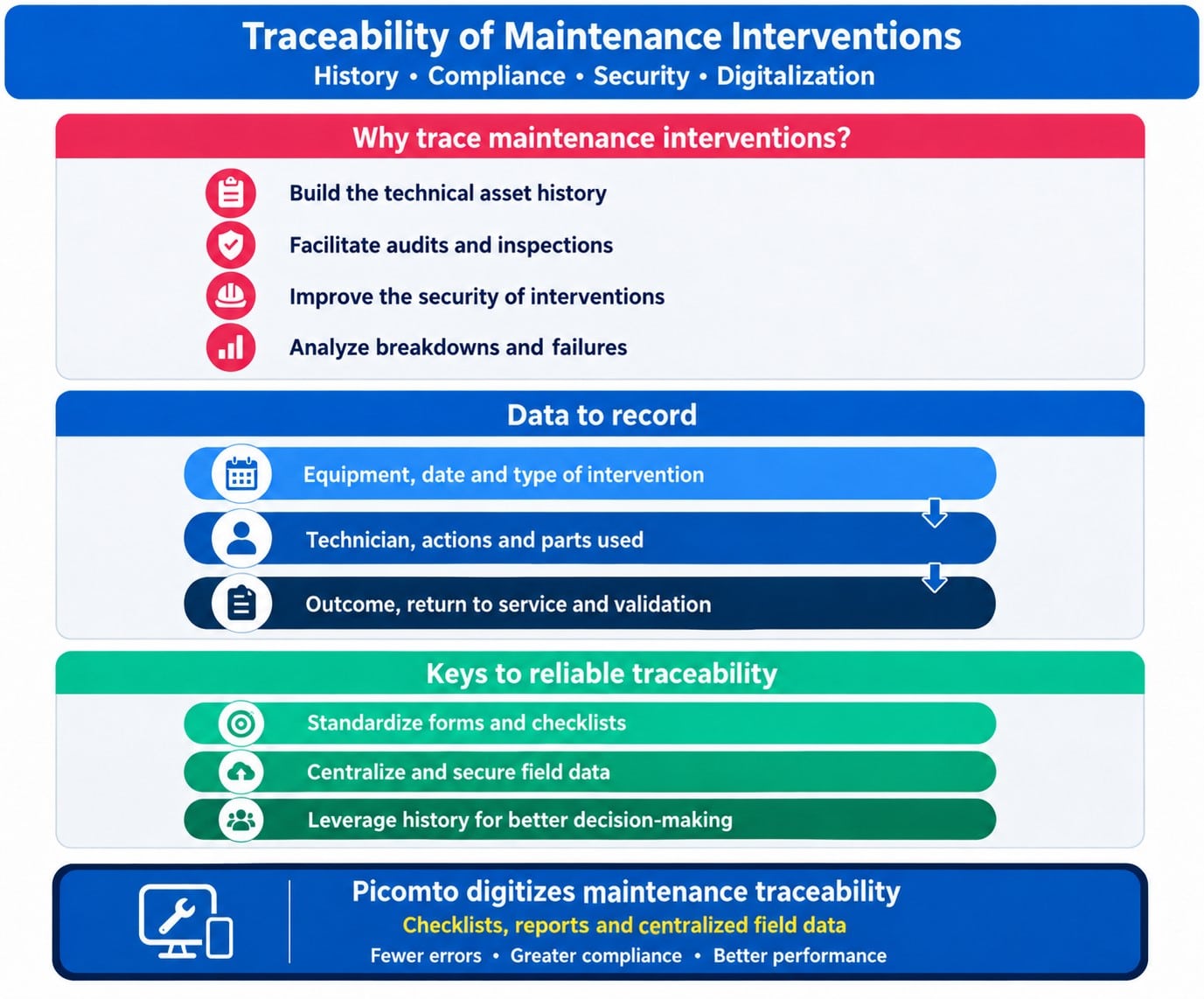
| Traceability consists of documenting, in a structured way, the equipment concerned, the intervention carried out, the technician involved, the date, the actions performed, and the result obtained. It makes it possible to reconstruct an asset’s technical history. NF EN 13306 provides the reference terminology for maintenance and covers, in particular, the various types and activities of maintenance. Source: AFNOR — NF EN 13306, Maintenance – Maintenance terminology. |
| Key Data — Maintenance Intervention Traceability: |
|---|
|
Key Takeaways on Maintenance Intervention Traceability:
- Regulatory compliance — Obligations depend on the equipment and the applicable texts.
- Operational memory — The history facilitates interventions and failure analysis.
- Safety — Up-to-date information improves operation preparation.
- Audits — Consistent documentation facilitates the search for evidence.
- Digitalization — Digital tools can standardize data entry and centralize data.
- Predictive maintenance — Reliable histories can feed failure trend analysis.
Emmanuel Toulisse, CEO of Picomto — LinkedIn
1. Why Is Maintenance Intervention Traceability an Operational and Legal Necessity?
Structured traceability makes it possible to monitor equipment condition, capitalize on interventions carried out, and meet maintenance or documentation obligations where applicable. It thus turns technical history into a management tool.
It improves day-to-day oversight and ensures reliable information is available during inspections or audits.

1.1. What Exactly Is Meant by Maintenance Intervention Traceability?
Traceability refers to the structured recording of every operation carried out on a piece of equipment. An intervention report must answer the following questions: which operator intervened, on which equipment, on what date, for what reason, with what resources, and with what outcome?
NF EN 13306 organizes maintenance terminology. INRS distinguishes, in particular, between corrective maintenance, carried out after a fault or malfunction is detected, and preventive maintenance, carried out at predetermined intervals or according to defined parameters. Sources: AFNOR — NF EN 13306 and INRS — Maintenance definitions.
1.2. What Legal Obligations Require Traceability in Maintenance?
Articles R4322-1 to R4322-3 concern maintaining compliance; Articles R4323-14 to R4323-21 concern use and maintenance.
Article R4323-19 specifies that ministerial orders determine the equipment or categories of equipment for which a maintenance logbook must be established and kept up to date. Articles R4323-20 and R4323-21 govern how it is made available and its format. Sources: Légifrance — maintaining compliance and Légifrance — maintenance logbook.
Requirements vary depending on the equipment, the risks involved, and the sector; the applicable framework must therefore be identified.
1.3. What Challenges Make Traceability Difficult to Maintain Day to Day?
The obstacles are numerous: volume of interventions, multiple technicians involved, manual data entry, scattered documents, or incomplete information.
In a multi-employer work setting, coordination becomes more complex. INRS notably recommends tracking interventions, coordinating simultaneous activities, conducting feedback reviews, and regularly updating maintenance documents. Source: INRS — Maintenance organization and prevention.
2. What Are the Concrete Benefits of Effective Intervention Traceability?
Effective traceability improves equipment knowledge, operation preparation, risk prevention, and performance analysis. It gives teams a shared memory and facilitates the use of maintenance data.
2.1. How Does Traceability Improve Operator Safety?
The history helps identify interventions, modifications, and risks already observed. INRS states that personnel must have access to the information needed for their activities: diagrams, maintenance documentation, and procedures.
It also recommends preparing and tracking interventions, inspecting equipment afterward, and keeping documents up to date. Source: INRS — Risk prevention in maintenance.
To go further: the Picomto webinar “Reducing Human Error” explores how digitalizing work instructions helps structure interventions and limit deviations in practice
2.2. What Impact Does Traceability Have on Intervention Quality and Equipment Availability?
A structured history facilitates preventive maintenance planning, analysis of recurring failures, and tracking of indicators such as MTBF, MTTR, downtime, and intervention frequency.
These KPIs are useful provided the underlying data is complete and consistent. A history also avoids repeating a diagnosis and helps prepare the intervention.
2.3. How Does Traceability Facilitate Audits and Relationships with Subcontractors?
Accessible documentation makes it possible to retrieve the history, validations, checks, and information requested during an audit.
It also clarifies the continuity of information with contractors. For outsourced interventions, INRS notably recommends exchanges on the history of operations and modifications made to the equipment. Source: INRS — Contracted and outsourced maintenance.
3. How Can Intervention Traceability Be Implemented: Methods, Tools, and Points of Vigilance?
Reliable traceability rests on three pillars: defining the relevant information, standardizing its collection, and organizing its storage so that it remains available and usable. The choice of tool must support this organization.

3.1. What Information Must Appear in an Intervention Record?
A traceable intervention report must contain, at minimum: equipment identification, the date and time, the nature of the intervention (preventive, corrective, etc.), the operator’s identity, parts used, the result and the equipment’s condition at restart, as well as a validation. On-site photos and structured forms usefully complement this textual data.
Picomto’s digital checklists make it possible to standardize this data collection directly from the field, on a smartphone or tablet, with automatic generation of the intervention report.
3.2. Manual or Digital Traceability: Which Solution to Choose?
| Criterion | Manual Traceability (Paper / Excel) | Digital Traceability (CMMS / Picomto) |
|---|---|---|
| Data reliability | Risk of errors and omissions | Guided entry, structured data |
| Time spent on entry | Time-consuming | Reduced through pre-filled forms |
| Regulatory compliance | Difficult to prove | Time-stamped and archived traceability |
| Data access | Limited, risk of loss | Centralized, accessible at any time |
| Multi-technician support | Complex to coordinate | Native, all participants included |
| Long-term cost | High hidden cost: searching, errors, re-entry | Upfront investment, gradual ROI |
Digitalization does not automatically ensure compliance: validation, access rights, archiving, and training remain essential.
3.3. How Can Traceability Be Managed in Multi-Employer and Subcontracting Settings?
In multi-technician environments, traceability must account for certifications, qualifications, and prevention plans.
INRS points out that coordination between outside companies is a critical aspect of document management. Shared digital tools allow every technician — internal or external — to contribute to the same intervention database.
Beyond day-to-day operations, well-managed traceability becomes a strategic lever in asset management.
4. How Does Intervention Traceability Fit Into an Asset Management and Predictive Maintenance Strategy?
Intervention histories are a valuable data source for tracking an asset’s lifecycle, understanding its behavior, and informing decisions on maintenance, overhaul, or replacement.
4.1. What Is the Link Between Traceability and Asset Management According to ISO 55000?
ISO 55000:2024 positions traceability as a pillar of asset management: historical data feeds decisions on equipment replacement, overhaul, or optimization.
AFIM translates this contribution into operational terms: without reliable history, asset management remains intuitive rather than data-driven.

4.2. How Does Digitalizing Traceability Prepare the Ground for Predictive Maintenance?
The progression can be summarized as follows: structured collection → reliable data → trend analysis → drift detection → maintenance decision.
Intervention histories can be cross-referenced with sensor data, operating parameters, inspections, or condition-based measurements. Inconsistent data, however, reduces the relevance of the analysis.
4.3. What Benefits Do Heavily Regulated Industries Gain from Advanced Digital Traceability?
In the pharmaceutical industry (GMP validation), aerospace (airworthiness), or chemicals (critical safety), the ability to instantly demonstrate compliance during regulatory inspections is decisive.
A unified platform for collecting, standardizing, and analyzing intervention data helps meet these requirements without adding administrative burden.
Conclusion
Maintenance intervention traceability is at once an operational memory, a prevention tool, and an asset management tool. In France, the Labour Code notably requires that equipment be kept in a compliant condition and provides for a maintenance logbook for certain categories determined by ministerial order. Sources: Légifrance — maintaining compliance and Légifrance — maintenance logbook.
On-the-ground difficulties can be reduced through structured organization and suitable tools.
Want to structure the traceability of your interventions in concrete terms?
Contact a Picomto expert for a personalized demonstration!
FAQ
What methods facilitate intervention traceability?
The most effective methods combine structured forms, checklists, a clear equipment identifier, and data collection carried out as close as possible to the intervention itself. A shared tool facilitates the centralization and use of the history.
Is intervention traceability mandatory in France?
Obligations depend on the equipment and the applicable framework. The Labour Code requires that equipment be kept in a compliant condition; Article R4323-19 provides for a maintenance logbook for certain categories determined by ministerial order. Sources: Légifrance — R4322-1 to R4322-3 and Légifrance — Article R4323-19.
What is the difference between preventive and corrective traceability?
Preventive traceability documents interventions carried out before a failure occurs, according to a schedule or monitoring parameters. Corrective traceability records actions carried out after a fault, defect, or malfunction is detected. Source: INRS — Maintenance definitions.
How should traceability be managed with subcontractors?
It is recommended that information be exchanged between the operating company and outside companies: history, modifications, risks, operations carried out, and end-of-intervention validation. INRS emphasizes this continuity of information. Source: INRS — Maintenance organization.
What is the link between traceability and predictive maintenance?
A structured history can be combined with condition or operating data. When this information is sufficiently reliable, it facilitates trend analysis and drift detection used in condition-based and predictive maintenance approaches.
Key Takeaways:
- Documenting interventions helps build a usable memory of equipment.
- Regulatory obligations depend on the equipment and the applicable texts.
- A reliable history facilitates interventions, failure analysis, and audits.
- Digitalization can improve data centralization and availability.
- In multi-technician settings, continuity of information is essential.
- Structured data forms a useful basis for asset management and predictive maintenance.











Leave A Comment