
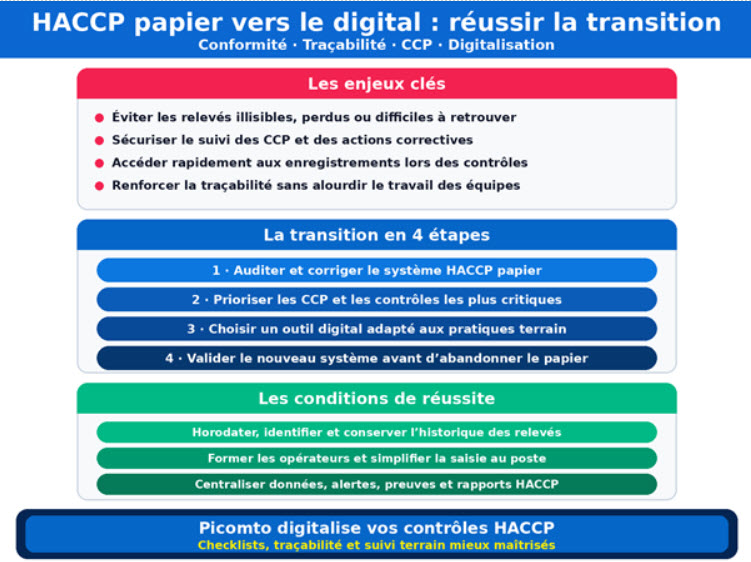
Moving from paper-based HACCP to digital is a structured transition that can be completed in four stages and can help strengthen regulatory compliance and food traceability. Yet how many quality managers still fill out binders by hand, search for a missing record the day before an audit, or try to decipher illegible entries?
In 2023, Santé publique France recorded 2,231 foodborne outbreaks (TIACs) in France, affecting 22,282 people and resulting in 19 deaths — the highest number recorded since 1987. These figures highlight the importance of a robust, rigorous and readily auditable HACCP system.
Digitalising HACCP management is not a technological revolution reserved for large corporations. It is a progressive approach that is accessible to very small businesses as well as mid-sized companies and fully compatible with the requirements of Regulation (EC) No 852/2004.
This article explains the legal framework, the limitations of paper-based records, the criteria for compliant electronic records, the step-by-step transition process and the key drivers of continuous improvement.
Would you like to see how digital checklists can replace your paper forms in practice?
| How do you move from paper-based HACCP to digital? |
|---|
| Moving from paper-based HACCP to digital involves four sequential stages: auditing the existing system, prioritising CCPs, deploying a suitable compliant tool and validating the new system in parallel before discontinuing paper records. Article 5 of Regulation (EC) No 852/2004 requires HACCP-related documentation and records to be established and retained. Electronic records can be used provided that the required information remains reliable and accessible. |
| Key figures — HACCP digitalisation |
|---|
|
Key points to remember when moving from paper-based HACCP to digital
- Audit before digitalising — Transferring a flawed paper-based system directly into a digital environment can simply reproduce and amplify existing problems.
- Prioritise CCPs — Starting with Critical Control Points allows the highest food safety risks to be addressed first.
- Validate both systems in parallel — Running paper and digital systems simultaneously for a limited period can help confirm data consistency before the final switchover.
- Apply appropriate record-control criteria — Electronic records should support reliable identification, traceability and control of important changes.
- Train frontline teams — Operator involvement is essential to the adoption of the digital system and the reliability of the data collected.
- Choose a multi-device solution — Using smartphones or tablets for HACCP checks facilitates real-time data entry directly at the point of work.
1. Is HACCP a legal requirement, and what are the consequences of a deficient system?
European legislation requires the relevant food business operators to implement procedures based on HACCP principles. However, documentation requirements must remain proportionate to the nature and size of the business.
1.1. Is HACCP a legal requirement for food businesses?
Article 5 of Regulation (EC) No 852/2004 requires the relevant food business operators to put in place, implement and maintain permanent procedures based on HACCP principles.
This obligation applies to the production, processing and distribution stages covered by the Regulation.
Documents describing the procedures must be kept up to date. Associated documents and records must also be retained for an appropriate period.
The Regulation additionally provides a certain degree of flexibility depending on the nature and size of the business.
In France, the Plan de maîtrise sanitaire (PMS), or Food Safety Management Plan, is the operational framework used by many food businesses to organise good hygiene practices, traceability and procedures based on HACCP principles.
1.2. What are the practical consequences of a deficient HACCP system?
Poorly implemented HACCP procedures increase several categories of risk.
- The first concerns food safety. Data published by Santé publique France illustrate the importance of rigorous food hazard control.
- The second concerns regulatory compliance. Food business operators must be able to demonstrate the effective implementation of their procedures to the competent authorities.
- The third concerns organisation and operational control. Incomplete or difficult-to-retrieve records make it harder to analyse deviations and monitor corrective actions.
- Finally, significant non-compliance can undermine the confidence of customers, auditors and contracting organisations.
- Why does paper reach its limits, and what are the actual benefits of HACCP digitalisation?
Paper-based HACCP systems can remain fully compliant when they are properly managed. However, their limitations become more significant as the number of records, users or sites increases.

2.1. Why do paper records reach their limits in a HACCP environment?
Paper documents can be lost, damaged or become difficult to read.
Processing the information also requires more manual handling. Someone may need to re-enter the data into a spreadsheet or another software system.
This additional data-entry step creates another opportunity for error.
In the 2009 Food Safety Magazine article "Moving from Paper to Electronic HACCP Records", Surak and Cawley highlight issues including administrative workload, transcription errors, difficulty retrieving certain records and record-retention constraints.
The publication remains relevant to the methodology used when transitioning from paper to electronic records. However, it should not be used as a regulatory reference for France or the European Union.
Digitalising a poor process is not enough. Existing organisational weaknesses should first be identified and corrected.
2.2. What are the demonstrated benefits of HACCP digitalisation?
Digital tools can improve the collection, availability and use of information.
The scientific review published by Plakantara and Karakitsiou in 2025 analysed 164 scientific publications covering the 2011–2023 period. The authors show that certain digital technologies can improve:
- real-time monitoring;
- traceability;
- automation;
- data utilisation;
- certain analytical and monitoring capabilities.
Depending on the selected solution, a company may use:
- digital forms;
- interactive checklists;
- on-site photographs;
- validation rules;
- alerts;
- automated reports;
- centralised record histories.
Picomto can notably be used to create digital checklists that operators can complete directly in the field.
To explore the subject further, Picomto’s “Eliminating Paper from the Shop Floor” webinar presents practical feedback and real-world experience with the digitalisation of operational records.
2.3. What specific challenges do SMEs face when transitioning HACCP to digital?
Digitalisation does not eliminate every difficulty. The study by Plakantara & Karakitsiou identifies several barriers, including:
- implementation costs;
- interoperability issues;
- insufficient digital skills in some organisations;
- difficulties integrating digital solutions with existing systems.
These barriers can be particularly significant for smaller businesses.
The project should therefore consider:
- the solution's total cost;
- compatibility with existing systems;
- access security;
- user training;
- form simplicity;
- change management and user support.
The tool should adapt to actual working practices. Businesses should avoid unnecessarily changing their operations simply to accommodate the software.
2. What criteria make an electronic HACCP record reliable and auditable?
| Criterion | Regulatory or control requirement | Implication for the digital system |
|---|---|---|
| Accuracy | Consistency with the control actually performed | Entry of the values actually recorded |
| Timing | Good traceability practice | Date and time associated with the check |
| Identification | Identification of the person making the record | User account, initials or signature |
| Legibility | Information must remain usable | Structured and readily accessible data |
| Accessibility | Availability during inspections or audits | Organised archiving and rapid retrieval |
| Integrity | Good auditability practice | History of validations or modifications |
Sources: FDA, 21 CFR 117.305 — presented here as an international good-practice reference; and Regulation (EC) No 852/2004.
3.1. What can the FDA reference contribute to electronic record quality?
For French or European businesses, FDA requirements are not the applicable regulatory framework.
However, they can serve as a useful supplementary international reference when defining certain documentary quality criteria.
FDA 21 CFR 117.305 notably provides that certain records must:
- contain actual values and observations obtained during monitoring;
- be accurate;
- be indelible and legible;
- be created concurrently with performance of the activity documented;
- identify the person performing the recorded activity.
These criteria can therefore be used as a good-practice checklist when defining the technical specifications for a digital HACCP solution.
They should not, however, be presented as obligations arising from European Union law.
3.2. What does European legislation say about electronic HACCP records?
Regulation (EC) No 852/2004 does not require the use of paper documents. Its primary requirement is that businesses be able to demonstrate implementation of their procedures and maintain the necessary documents and records.
It would therefore be inaccurate to state that Article 5 systematically requires:
- an electronic signature;
- automatic timestamping;
- an absolute prohibition on subsequent modification;
- a specific archiving technology.
These functionalities may nevertheless be highly relevant for strengthening auditability and traceability.
3.3. Which technical features should be prioritised?
A digital HACCP solution should enable the organisation to:
- identify the user;
- associate a date and time with each check;
- collect information directly in the field;
- retain the relevant record history;
- control access rights;
- retrieve a record quickly;
- export the required information;
- back up data;
- document significant corrections.
Discover Picomto’s data collection feature, designed to centralise field records and facilitate preparation for food safety inspections and audits.
4. How do you move from paper-based HACCP to digital in four practical steps?
The transition should follow a progressive methodology. The article by Surak & Cawley published in Food Safety Magazine provides a useful methodological foundation.
However, it was published in 2009. It should therefore be cited for its transition methodology rather than as a source of current regulatory requirements.

Step 1 — How should you audit and correct your paper-based HACCP system before digitalising it?
Begin by analysing the existing system.
Review the quality of the forms, monitoring frequencies and recurring deviations.
The audit should examine:
- the completeness of procedures;
- the legibility of records;
- the checks actually performed;
- corrective actions;
- document availability;
- user responsibilities.
Surak and Cawley recommend correcting weaknesses in the paper-based system before converting it to an electronic format.
The principle is straightforward: automating a poor procedure does not make it better.
Step 2 — Why and how should CCPs be prioritised during digitalisation?
CCPs, or Critical Control Points, cover controls that are essential for controlling certain food safety hazards.
Surak and Cawley identify CCP-related data as a relevant area with which to begin an electronic transition. The system can then gradually be extended to other programmes and records.
Prioritisation can take into account:
- the level of risk;
- monitoring frequency;
- data volume;
- the number of users;
- the need for rapid intervention;
- existing difficulties in consolidating information.
Step 3 — How do you choose a digital HACCP tool suited to your organisation?
Which solution should you select to digitalise your HACCP approach? The tool must address the organisation’s actual operational constraints.
In particular, assess:
- compatibility with smartphones, tablets and computers;
- form customisation;
- access-right management;
- validation rules;
- report generation;
- data history;
- export capabilities;
- interoperability;
- ease of use;
- quality of support.
A more complex solution is not necessarily a better one.
Operators should be able to carry out their checks without having to perform unnecessary additional steps.
Step 4 — How should you validate your digital HACCP system before discontinuing paper records?
First test the system within a representative operational scope.
Check:
- data consistency;
- completeness of forms;
- user understanding;
- correct operation of alerts;
- availability of records;
- management of deviations.
Surak and Cawley also recommend validating the electronic system before paper records are permanently discontinued.
This validation should notably verify user competence and data quality.
A temporary period during which the paper and digital systems operate in parallel can therefore help secure the transition.
However, such a parallel-running period is not a general requirement under Regulation (EC) No 852/2004.
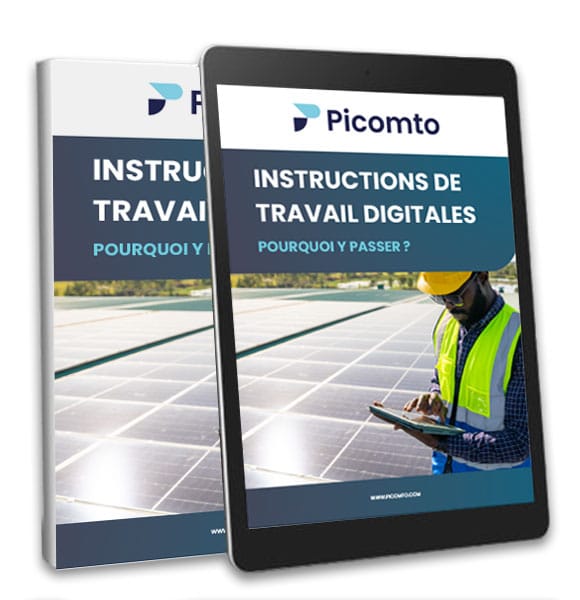
For further information about the methodology, you can also consult Picomto’s resources on digital work instructions.
E-book CTA: To structure your approach, download Picomto’s e-book on digital work instructions, which presents practical methods for standardising and deploying shop-floor procedures.
Conclusion
Moving from paper-based HACCP to digital should not be considered an additional constraint. It is a structured approach that can help organisations improve risk control, facilitate audits and free up operational time.
In a context where regulatory requirements remain demanding and food safety risks continue to be significant, this transition can contribute to sustainably improving the performance of frontline teams.
Would you like to see how Picomto can digitalise your HACCP records? Request a demonstration and discover how food industry businesses have structured their transition.
FAQ
What are the benefits of moving from paper-based HACCP to digital?
Digital systems make it easier to centralise, retrieve and analyse records. They can also provide alerts, automated reports, better use of collected data and faster access to historical information.
What are the steps involved in digitalising a HACCP plan?
Begin by auditing the existing system. Then prioritise critical controls, select an appropriate solution, train users and validate its operation before the final switchover.
The methodology described by Surak & Cawley provides a useful reference for structuring this transition.
How long is a HACCP training certificate valid?
A distinction must be made between the HACCP system itself and specific food hygiene training requirements applicable to certain establishments.
Training obligations vary depending on the activity and the applicable regulatory framework. A certificate should therefore not automatically be described as having a universally applicable validity period.
Which tool should you choose to digitalise your HACCP approach?
Choose a tool that fits operational constraints, can be customised and is accessible on the devices actually used by your teams.
Also assess:
- user management;
- data history;
- export capabilities;
- archiving;
- security;
- support;
- ease of use.
Which documents must be provided during a HACCP inspection?
The business must be able to demonstrate effective implementation of its procedures based on HACCP principles.
Regulation (EC) No 852/2004 provides in particular for the establishment of documents and records appropriate to the nature and size of the food business.
The information required will depend on the HACCP system implemented and the activity concerned.
What are the three types of HACCP hazards?
Hazards are generally classified into three main categories:
- Biological hazards: bacteria, viruses and parasites.
- Chemical hazards: contaminants, residues or undesirable substances.
- Physical hazards: glass, metal, plastic or other foreign bodies.
Allergens should also be included in the hazard analysis whenever they are relevant to the activity.
What are the seven HACCP principles?
The seven principles are:
- conduct a hazard analysis;
- determine the Critical Control Points (CCPs);
- establish critical limits;
- establish a monitoring system;
- establish corrective actions;
- establish verification procedures;
- establish appropriate documentation and record-keeping procedures.
These principles form the foundation of the HACCP system.
Which HACCP references should be consulted in 2026?
For a French or European business, the priority references are:
- French legislation applicable to the relevant sector;
- validated guides to good hygiene practices;
- the Codex Alimentarius for internationally recognised HACCP principles.
For additional information on specific aspects:
- Santé publique France — 2023 TIAC report for French foodborne outbreak data;
- Plakantara & Karakitsiou, 2025 for the benefits and limitations of digitalisation;
- Surak & Cawley, 2009 for the methodology used to transition from paper to electronic records;
- FDA — 21 CFR 117.305 solely as a supplementary U.S. reference concerning record quality.
Key takeaways
- Audit the paper-based system before digitalising it.
- Correct existing weaknesses before automating processes.
- Begin with the most critical controls.
- Digital records must remain readily accessible.
- Timestamping and record histories strengthen traceability.
- FDA requirements should remain a comparative reference and not be presented as the European regulatory basis.
- Validate the new system before permanently discontinuing paper records.
- Provide training for operators and adapt the tool to their working practices.
- Base legal and regulatory claims on EUR-Lex and the relevant competent authorities.










Leave A Comment