
Digital work instructions in aviation are interactive, traceable, multimedia procedures that replace paper-based documentation in MRO maintenance operations. In an industry where there is structurally no room for error, this transition is no longer an optional strategic choice. It is a direct response to regulatory requirements and operational realities on the shop floor.
Yet many maintenance organizations still rely on paper work packages that are vulnerable to revision-control errors, skipped steps, and gaps in traceability. How can this divide between regulatory expectations and operational reality be explained?
The Eversberg & Lambrecht study on digital work instructions versus paper-based documents, published in 2023, provides tangible evidence. The study found that participants completed the repair task 21% faster and reported a 26% lower perceived workload when using the digital assistance system. All participants preferred the digital system to the paper-based workflow.
This article examines the limitations of paper, the applicable regulatory framework, measurable performance gains, and the key factors behind successful deployment.
Want to understand how other industrial organizations have made this transition? Explore the Picomto case studies for practical field feedback.
| What Are Digital Work Instructions in Aviation? |
|---|
| Digital work instructions in aviation are interactive, time-stamped, and traceable procedures that structure the execution of maintenance tasks. They can include text, images, videos, measurements, mandatory validation steps, photographs, and automatically recorded execution data. Unlike a static PDF, a digital work instruction can guide technicians throughout the maintenance process while recording evidence of task completion. They operate within a regulatory environment in which maintenance data, records, access rights, revision control, and data integrity are essential. |
| Key Data — Digital Work Instructions in Aviation |
|---|
|
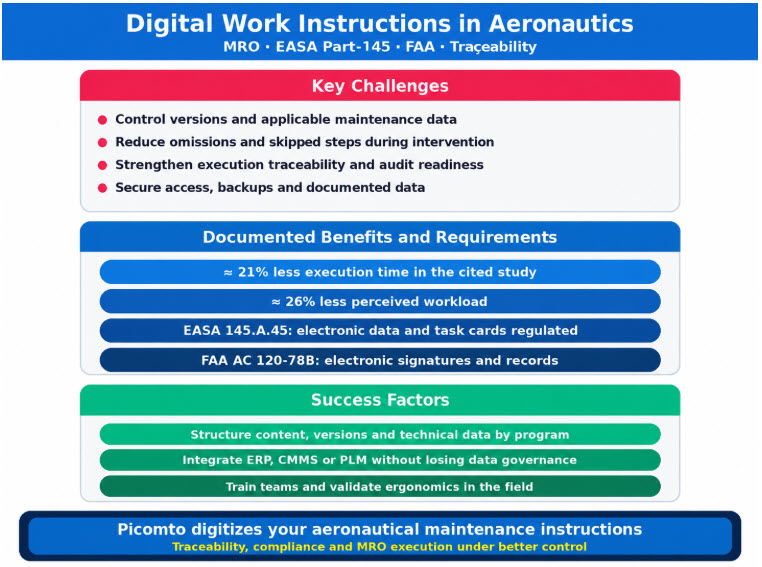
Key Data — Digital Work Instructions in Aviation :
- Structured regulatory compliance — Digital work instructions can support compliance with Part-145 requirements when appropriate revision control, access protection, data integrity, and backup mechanisms are implemented.
- Reduced risk of omissions — Step-by-step guidance can help prevent technicians from inadvertently skipping verification steps.
- Measured productivity gains — The independent study by Eversberg and Lambrecht documented a 21% improvement in task-completion time.
- End-to-end traceability — Digital systems can create searchable and time-stamped execution histories, simplifying the retrieval of evidence during audits.
- Information security is becoming increasingly important — The IAQG's 2023 IA9100 revision material proposed stronger requirements relating to information security and electronically managed documented information.
- Shop-floor adoption remains critical — Performance gains only materialize when operators actually use and accept the system.
Emmanuel Toulisse, CEO of Picomto (LinkedIn)
1. Why Is Paper Reaching Its Limits in Aircraft Maintenance?
Aircraft maintenance is one of the most demanding industrial environments in terms of documentary accuracy. Yet paper documentation remains widespread, with tangible operational and regulatory consequences.
Understanding these limitations is an essential starting point before evaluating any solution for digitizing work instructions.

1.1. What Specific Operational Safety Risks Are Associated With Paper?
Paper instructions expose maintenance teams to several operational risks. An obsolete revision distributed by mistake may lead a technician to apply an outdated procedure.
Paper workflows can also make systematic step validation more difficult. Without appropriate controls, technicians may proceed without documenting that a required verification has been completed.
The Eversberg & Lambrecht study examined a turbine-blade repair task performed by ten experienced workers.
The researchers observed differences between the established paper workflow and the digital assistance system. Certain checks could be missed in the paper process, whereas the digital system explicitly presented the relevant verification steps.
In an industry where aircraft airworthiness depends directly on the quality and accuracy of maintenance execution, such deviations cannot be considered insignificant.
1.2. How Does Paper Weaken Traceability During MRO Audits?
Reconstructing a complete maintenance history from paper archives can be a lengthy process.
Documents may be lost, incorrectly filed, difficult to retrieve, or disconnected from reliable electronic timestamps. When evidence is required during an audit, fragmented documentation can make demonstrating compliance more difficult.
Digital systems can address these limitations through real-time data capture, controlled user access, timestamps, revision histories, and automatically generated maintenance reports.
These capabilities do not make a system compliant by themselves. They provide technical mechanisms that organizations can configure within their approved quality and maintenance processes.
1.3. What Hidden Costs Does Paper Generate for Maintenance Organizations?
Beyond operational risk, paper generates costs that are often underestimated.
These include printing, distribution, manual updating of work packages, archiving, document retrieval, and technician time spent identifying the applicable revision.
Paper processes can also require information to be manually re-entered into ERP, CMMS, MES, or quality-management systems.
Digital work instructions can reduce these repetitive tasks by capturing data directly during maintenance execution.
The regulatory environment increasingly accommodates electronic records. The next question is therefore what requirements organizations must consider.
2. What Regulatory Framework Governs Digital Work Instructions in Aviation?
Moving from paper to digital documentation is not simply a modernization initiative.
Aircraft maintenance organizations operate within strict regulatory, quality, and documentation frameworks. Digital tools must therefore preserve the reliability, integrity, availability, and traceability expected from maintenance records.
2.1. What Does EASA Part-145 Say About Digital Work Instructions?
The European regulatory reference is Regulation (EU) No 1321/2014, Annex II — Part-145.
Point 145.A.45, "Maintenance data," governs the maintenance data and work documentation used by Part-145 organizations.
The framework accommodates computer-generated work cards and electronically managed documentation when appropriate controls are applied.
For a Part-145-approved maintenance organization, deploying a digital work-instruction platform therefore requires particular attention to document control, authorization, data integrity, revision management, and backups.
The technology itself does not provide regulatory compliance. Compliance depends on how it is configured, controlled, documented, and integrated into the organization's approved processes.
2.2. What Does FAA AC 120-78B Say About Electronic Records?
The current FAA reference is Advisory Circular 120-78B, "Electronic Signatures, Electronic Recordkeeping, and Electronic Manuals".
The FAA issued AC 120-78B on December 11, 2024. Its status is listed as active, and it replaced AC 120-78A.
The document provides standards and guidance for electronic signatures, electronic records, and electronic manual systems used for information required by Title 14 of the Code of Federal Regulations.
However, the distinction between regulation and guidance is important.
AC 120-78B explicitly describes an acceptable means, but not the only means, of meeting applicable requirements. The Advisory Circular itself does not have the force and effect of law.
This distinction should be preserved when assessing FAA compliance.
2.3. What Does the IAQG Say About Electronic Document Control and Information Security?
The IAQG "IA9100 Key Change Summary" published in November 2023 provides useful insight into the direction of aerospace quality-management requirements.
The document proposed a new clause 7.1.7 on Information Security and described further refined requirements under clause 7.5.3 when documented information is managed electronically.
These developments illustrate the increasing importance of protecting electronically managed quality information.
However, this source must be interpreted carefully.
The document is a 2023 key-change and revision-planning document. It described changes proposed for the future IA9100 revision. It should therefore not be cited as evidence that those provisions were already requirements of the then-current 9100 standard.
For current certification decisions, organizations should always verify the latest officially published standard and IAQG transition information.
3. What Tangible Benefits Do Digital Work Instructions Provide in Aviation?
Beyond regulatory considerations, digital work instructions can influence operational performance.
Independent research provides measurable evidence without relying solely on software-vendor claims.

3.1. How Do Digital Instructions Help Reduce Human Error?
The Eversberg & Lambrecht study compared an augmented-reality digital assistance system with an established paper-based workflow for a turbine-blade repair task.
Ten experienced workers took part in the study.
The digital system presented task-specific instructions and spatial information and structured the sequence in which relevant information was displayed.
This type of guidance can help make required checks more visible and reduce the risk of inadvertent omissions.
Digital instructions can also support less experienced personnel by presenting contextual information directly at the point of work.
However, digitalization does not eliminate human error automatically. The quality of the instructions, interface design, data accuracy, training, and organizational processes remain decisive.
3.2. Comparison Table — Paper vs Digital in Aircraft Maintenance
Criterion
| Criterion | Paper Instructions | Digital Instructions |
|---|---|---|
| Version control | Manual, risk of obsolete revisions | Centralized, controlled updates |
| Step validation | Limited automatic enforcement | Sequential validation can be configured |
| Traceability | Often reconstructed after execution | Time-stamped execution data |
| Audit preparation | Manual document retrieval | Searchable records and generated reports |
| Shop-floor accessibility | Printing and physical distribution | Tablet, workstation, or mobile access |
3.3. What Productivity Gains Have Studies Documented?
The results published by Eversberg & Lambrecht show two particularly relevant findings.
Participants completed the manual repair task 21% faster with the digital assistance system.
They also reported a 26% lower perceived workload.
All ten participants stated that they preferred the digital assistance system to the paper documents.
These results should be interpreted within the scope of the study rather than automatically extrapolated to every aircraft maintenance activity.
Nevertheless, they demonstrate that well-designed digital instructions can improve performance in a realistic, object-specific repair environment.
In operational terms, faster task execution may contribute to shorter cycle times, better utilization of maintenance resources, and potentially reduced aircraft ground time.
4. How Can Digital Work Instructions Be Deployed Effectively in an Aviation Environment?
A common question among maintenance and digital-transformation managers is: How do you select a digital solution suited to the aviation environment?
The answer depends on technical architecture, documentation standards, integration capabilities, regulatory constraints, cybersecurity, and shop-floor adoption.
4.1. Which Technical Standards Support Interoperability?
One of the major standards for structured aerospace technical information is S1000D.
S1000D is an international specification for technical-publication development.
It was initially developed within the Aerospace, Security and Defence Industries Association of Europe and is now jointly produced by ASD, the Aerospace Industries Association of America (AIA), and the ATA e-Business Program.
The first issue was released in 1989, while the latest released version listed by the official S-Series website is Issue 6.
S1000D structures technical information into reusable data modules rather than treating documentation as a collection of independent static files.
This architecture provides several benefits, including interoperability based on open standards, reuse of technical data, standardized information structures, and lower update costs.
The official S1000D information is available at S-Series.org.
Selecting suitable data formats and standards early in a project directly affects the long-term sustainability of a digital solution.
It also influences integration with ERP, CMMS, MES, PLM, and other maintenance-information systems.
A digital work instruction should therefore not be viewed simply as a PDF displayed on a tablet. It can become a structured, version-controlled data object connected to maintenance work packages and operational records.
4.2. Which Organizational Conditions Support Shop-Floor Adoption?
Access to information at the point of use is essential.
A system that becomes inaccessible when connectivity is lost, or that is incompatible with workshop devices, creates operational friction.
Depending on the maintenance environment, compatibility with tablets, smartphones, rugged devices, and workshop computers may therefore be important.
Employee training and onboarding constitute another major success factor.
An ergonomic interface adapted to shop-floor conditions can reduce resistance to change and shorten the learning curve.
Configuration management, option management, non-conformance workflows, and verification steps should also remain manageable without unnecessary technical complexity.
No-code or low-code process updates can give methods and engineering teams greater autonomy while preserving controlled workflows and governance.
Conclusion
Digital work instructions in aviation address three distinct challenges: reducing the operational limitations of paper documentation, supporting regulatory and quality-management requirements, and improving maintenance performance.
The transition from paper to digital is therefore increasingly a question of how, rather than simply whether, to digitalize.
The regulatory environment provides important reference points.
EASA Part-145 establishes the European framework for approved maintenance organizations and maintenance data. FAA AC 120-78B provides current FAA guidance for electronic signatures, electronic recordkeeping, and electronic manuals. The IAQG IA9100 Key Change Summary demonstrates the growing importance of information security and electronic document control in aerospace quality-management discussions, while remaining a revision-planning document that must not be confused with an already applicable published revision. S1000D provides a recognized framework for structured and reusable technical information. Finally, the Eversberg & Lambrecht study provides independent evidence that appropriately designed digital work instructions can improve task-completion time and reduce perceived workload.
Successful deployment ultimately rests on three pillars: interoperable technical standards, integration with existing systems, and effective shop-floor adoption.
Want to assess how to digitize your work instructions while addressing EASA and FAA requirements? Discover how to structure your transition with a solution designed around aircraft-maintenance constraints
FAQ
What Is a Digital Work Instruction in the Aviation Industry?
A digital work instruction is an interactive, controlled, and traceable procedure that guides a technician during a maintenance task. It can provide step-by-step guidance while collecting time-stamped execution data, measurements, photographs, and validation records.
Within a Part-145 environment, the associated maintenance data and documentation must be managed according to the applicable regulatory and organizational controls.
What Are the Benefits of Switching to Digital Work Instructions?
Digital work instructions can improve revision control, reduce the risk of skipped steps, strengthen traceability, and simplify access to maintenance records. The Eversberg & Lambrecht study reported a 21% reduction in task-completion time and a 26% reduction in perceived workload for the repair task examined.
What Is Aircraft Maintenance?
Aircraft maintenance includes inspection, servicing, repair, modification, and overhaul activities performed to preserve or restore the airworthiness of an aircraft or component. In Europe, approved maintenance organizations operate within the framework established by Regulation (EU) No 1321/2014 and Part-145. In the United States, FAA regulations and associated guidance establish requirements relating to maintenance activities and records.
What Features Should an Aviation Digital Work-Instruction Platform Provide?
Relevant capabilities may include sequential task validation, controlled revision management, role-based access, real-time data capture, photographic evidence, timestamps, electronic records, automated reports, offline access, and integration with ERP or CMMS platforms.
The exact configuration must reflect the organization's maintenance approvals, procedures, IT architecture, and quality-management system.
Key Takeaways :
- Paper creates operational limitations: outdated revisions, fragmented traceability, manual archiving, and potentially missed steps can make maintenance workflows harder to control.
- EASA provides the European regulatory framework: Part-145 and point 145.A.45 are key references for maintenance data.
- FAA AC 120-78B is the current FAA guidance: AC 120-78B is active and replaced AC 120-78A, but remains guidance rather than a regulation.
- Independent performance gains have been measured: the Eversberg & Lambrecht study reported 21% faster task completion and 26% lower perceived workload.
- Interoperability should be planned from the outset: S1000D provides an established framework for modular and reusable technical information.
- Electronic information security is becoming increasingly important: the 2023 IAQG IA9100 Key Change Summary proposed stronger provisions relating to information security and electronically managed documented information.
- Shop-floor adoption matters as much as technology: training, usability, accessibility, and integration into existing maintenance processes remain critical success factors.











Leave A Comment