
Optimizing human resources in production refers to the full set of methods, tools, and practices that align available skills with the operational needs of an industrial site, while complying with applicable legal and regulatory requirements. Yet in a context of skilled labor shortages, how can production managers maintain performance, compliance, and engagement simultaneously? According to France Travail’s 2026 BMO (Besoins en Main-d’Œuvre) data, 47.9% of recruitment projects in industry are considered difficult to fill. This pressure calls for structured talent management, skills traceability, and frontline employee experience.
If you’re looking to structure your approach, the Picomto webinar on digitalizing training in production offers a concrete introduction to today’s challenges.
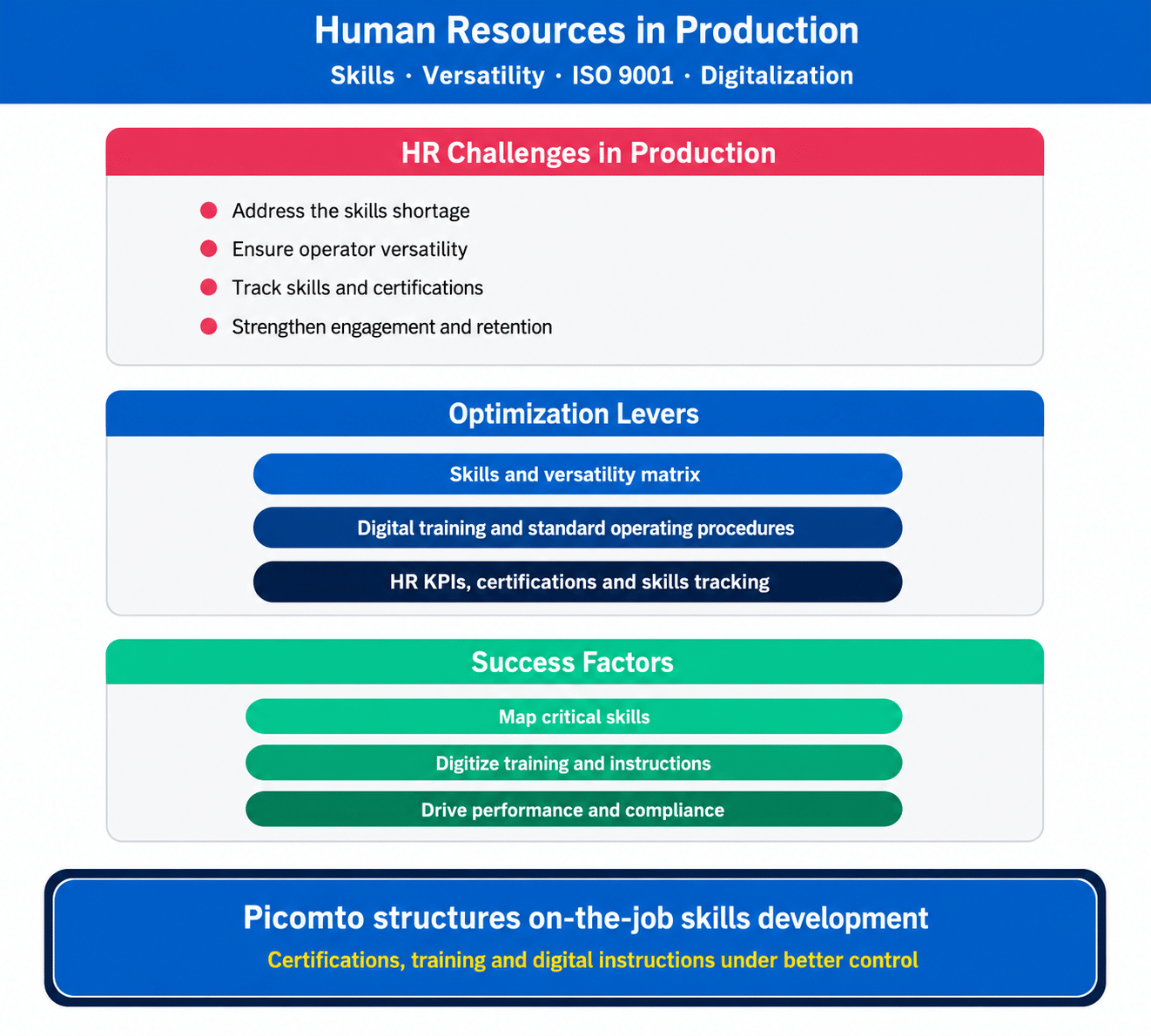
This article covers, in turn: the underlying drivers of the HR challenge in production, the applicable legal framework, concrete operational levers, the engagement and retention dimension, and finally the available digital solutions.
| QWhat Is Human Resources Optimization in Production? |
|---|
| Optimizing human resources in production consists of structuring skills management, operator versatility, and qualification traceability to support operational performance and regulatory compliance. It combines work organization, skills development, and mastery of applicable requirements. |
| Key Data — HR Optimization in Production: |
|---|
|
| Key Takeaways on HR Optimization in Production : |
|---|
|
Emmanuel Toulisse, CEO of Picomto — LinkedIn
1. Why Has Human Resources Optimization in Production Become Essential?
The tension between industrial needs and the availability of skills has intensified in recent years. Understanding its root causes helps identify the right levers for action, rather than responding to urgency in a disorganized way.

1.1. What Pressures Are Currently Weighing on Workforces in Industrial Environments?
An aging workforce is accelerating the loss of tacit know-how. Cross-sector competition for qualified technical profiles is intensifying.
France Travail’s 2026 BMO data shows that 47.9% of recruitment projects in industry are considered difficult to fill. At the same time, L’Usine Nouvelle reports 129,600 hires announced for 2026, compared to 182,500 in 2024, according to data relayed by Carif-Oref Provence-Alpes-Côte d’Azur. The overall decline in hiring intentions does not, therefore, erase the persistent difficulties around certain technical profiles.
Passing on processes between generations of operators is thus becoming a critical issue for industrial continuity.
1.2. How Does Skills Management Directly Affect Operational Performance?
Assigning operators to positions for which they are insufficiently trained or qualified creates quality risks. Conversely, an up-to-date versatility matrix makes it easier to anticipate absences and replacement needs.
Skills development contributes to process control: a properly trained operator has a better understanding of the standards, checks, and expected responses at their workstation.
HR performance indicators — versatility rate, up-to-date qualification rate — can then be cross-referenced with OEE (Overall Equipment Effectiveness) and quality data.
1.3. What Concrete Risks Does a Plant Face by Neglecting HR Optimization?
Poor documentation management exposes the company to nonconformities during certification audits. Accelerated turnover, often linked to poor onboarding and a lack of ongoing employee training, increases recruitment and integration costs.
Finally, a lack of qualification traceability can lead to nonconformity during an ISO or IATF audit, with consequences that vary depending on severity.
These findings raise the question of the legal and regulatory framework that applies to manufacturers.
2. What Legal and Regulatory Obligations Govern HR Management in Industrial Production?
Regulatory compliance is not a secondary objective: it plays a part in the control of skills, processes, and applicable requirements. Understanding this framework helps prioritize HR investments.
2.1. What Does the Labor Code Say About Workforce and Skills Planning (GEPP) in Industry?
Article L2242-20 of the French Labor Code requires companies and corporate groups covered by the requirement with at least 300 employees to negotiate every three years on the management of jobs and career paths, including a workforce and skills planning mechanism (GEPP).
This obligation notably covers anticipating skills changes and the associated support measures.
For industrial sites, this means having a structured view of jobs, critical skills, and development paths. Below the legal threshold, GEPP remains good practice for anticipating HR needs.
2.2. What Quality Standards (ISO 9001, IATF, EN 9100) Impose Requirements on Skills and Traceability?
Clause 7.2 of ISO 9001:2015 requires an organization to determine the necessary competence, ensure that the relevant people possess it, and retain appropriate documented information as evidence of competence. The ISO/IAF guidance document on competence specifies how this requirement can be assessed during an audit.
These requirements are supplemented by sector-specific frameworks such as IATF 16949 in automotive and EN 9100 in aerospace. Traceability of skills and qualifications is therefore a verifiable element during audits.
2.3. What Are the Concrete Risks of HR Nonconformity During a Certification Audit?
Insufficiently documented skills management can lead to nonconformity during an audit, with severity depending on context and the requirements involved.
Consequences may include implementing a corrective action plan, additional verifications, and, in some cases, impacts on certification maintenance. Tools such as Picomto help structure the traceability of instruction consultations and field validations, providing usable data during an audit.

3. What Are the Operational Levers for Optimizing Human Resources in Production?
Moving from observation to action requires identifying the concrete levers available on an industrial site. Three of them structure the majority of effective approaches.
3.1. How Does the Versatility Matrix Improve Operator Assignment in Production?
The skills and versatility matrix records, for each operator, the positions mastered and the associated level: in training, autonomous, or expert. It allows the production manager to assign available resources, anticipate ongoing training needs, and plan for succession.
Regularly updating it is a prerequisite for any effective HR process on the shop floor. When based on traceable assessments and validations, it can contribute to the evidence of competence required under Clause 7.2 of ISO 9001:2015, in line with the recommendations of the ISO/IAF guidance document on competence.
3.2. How Does Digitalizing Work Instructions Transform Skills Development on the Shop Floor?
Work instructions accessible on tablet or smartphone speed up access to information and make it easier to onboard employees from day one.
Digitalizing human resources here means dematerializing training materials: no more paper binders that are hard to keep up to date — instead, illustrated work instructions, interactive checklists, and traceable validation forms.
Picomto centralizes the creation, distribution, and monitoring of these instructions, supported by field data collection.
Discover how Picomto structures the digitalization of work instructions to accelerate skills development in production
3.3. Which Key HR Indicators Help Manage Operational Efficiency in Production?
Relevant HR KPIs in production include: versatility rate per line, up-to-date qualification rate, average time-to-competency on a new position, and the error rate attributable to the human factor when identified.
These HR performance indicators, cross-referenced with OEE and quality data, enable objective management of organizational performance. They also feed into HRIS dashboards for HR management and support employee feedback.
4. Beyond Productivity: How Does HR Optimization Strengthen Engagement and Talent Retention in the Plant?
Operational performance and employee engagement are not opposed — they can reinforce one another. In its framework dedicated to QVCT (quality of life and working conditions), Anact places the organization, content, and actual conditions of work at the heart of the approach.

4.1. What Is the Link Between Quality of Work Life (QWL) and Operational Performance in Production?
A well-suited work environment can help reduce certain causes of disengagement and turnover. Employee satisfaction is closely tied to task clarity, recognition of skills, and team cohesion.
A work-centered approach, incorporating regular feedback and career progression based on versatility, fosters the retention of qualified profiles.
4.2. How Does Access to Clear Instructions and Digital Tools Improve the Operator Experience?
Giving operators the right tools reduces the difficulties associated with searching for information during complex tasks. Clear digital work instructions, accessible independently, strengthen mastery of the workstation.
Trust is also built by providing suitable resources. Reducing administrative tasks linked to searching for paper documents frees up time for higher-value activities.
4.3. What Management Practices Foster Employee Retention in Industrial Environments?
Recognizing skills through a visible matrix, involving operators in standardizing procedures, and structured feedback are concrete retention levers.
Ongoing employee training, integrated into a formalized skills development path, also strengthens the continuous improvement dynamic at the shop-floor level.
5. How to Digitalize and Automate HR Traceability in Production? The Contribution of Specialized Industrial SaaS Solutions
What tools enable successful HR optimization in production? The answer depends on the site’s level of digital maturity and the applicable regulatory requirements.
5.1. What Are the Differences Between a General-Purpose ERP, Paper-Based Tools, and a Specialized Industrial SaaS Solution for HR Management?
| Criterion | Paper-Based Tool | General-Purpose ERP | Specialized Industrial SaaS (e.g., Picomto) |
|---|---|---|---|
| Qualification traceability | Manual, unreliable | Partial, limited shop-floor relevance | Automated, auditable |
| Shop-floor accessibility | Limited | Low: desktop PC | Mobile, tablet, shop floor |
| ISO / IATF compliance | Not demonstrated | Partial | Supports compliance |
| Instruction updates | Slow, risk of outdated versions | Complex | Real-time, centralized |
| Field data collection | Absent | Limited | Integrated: forms, photos |
This table illustrates the differences in use between paper-based tools, general-purpose ERPs, and solutions specialized for field operations. Actual functionality nonetheless depends on each solution and its configuration.
5.2. What Concrete Use Cases Does Picomto Cover for HR Optimization in Production?
Picomto helps structure document management in production (digital work instructions), training (traceable skills development), quality (checklists, audit reports), and maintenance (digital procedures).
These use cases cover sectors with high quality and traceability requirements: pharmaceuticals, aerospace, chemicals, and defense. At Daher, for example, Picomto is used to create and distribute work instructions as well as to verify and trace skills checklists, as shown in the case study published by Picomto.
5.3. How Does a Platform Like Picomto Help Prepare Evidence of Competence for an Audit?
A digital platform makes it possible to keep a history of instruction consultations, field validations, and information associated with skills or qualifications.
This data forms a traceable history that can be used during an ISO 9001, IATF 16949, or EN 9100 audit, provided it matches the requirements and criteria defined by the company. Automating document processes also reduces the risk of oversights or outdated versions.
Conclusion
Optimizing human resources in production is at once a regulatory and normative issue (GEPP, ISO 9001:2015), an operational imperative (versatility, traceability, HR KPIs), and a human lever (QVCT, employee engagement, retention).
In a context where France Travail’s 2026 BMO data shows that 47.9% of recruitment projects in industry are considered difficult to fill, companies that structure their skills management and digitalize their work instructions give themselves the means to better reconcile compliance, productivity, and HR attractiveness.
Digitalizing human resources is not an end in itself: it is a means of making frontline teams more autonomous, better trained, and more engaged.
Want to see how Picomto fits into your HR optimization approach?
Request a personalized demo tailored to your sector and compliance challenges.
FAQ
What Is Human Resources Optimization in Production?
Optimizing human resources in production refers to the set of methods used to align available skills with the operational needs of an industrial site, incorporating talent management, qualification traceability, and skills development. It aims to improve organizational performance while complying with applicable legal and regulatory obligations.
What Are the 4 Pillars of Human Resources in an Industrial Setting?
The four pillars are: structured recruitment and employee onboarding, skills development and ongoing training, performance management via HR KPIs, and employee retention. In production, each pillar must be adapted to the site’s operational and regulatory constraints.
What Are the 4 Steps of Continuous Improvement Applied to HR in Production?
The four steps of the PDCA cycle applied to HR are: Plan (map skills and gaps), Do (train, qualify, digitalize instructions), Check (measure HR KPIs and performance indicators), and Act (update matrices, procedures, and training paths). This logic structures a sustainable HR approach.
What Are the 4 Main Functions of Human Resources in Production?
The four main functions are: administrative management and regulatory compliance, skills development and training, organizational performance management, and quality of life and working conditions. In an industrial environment, these functions are exercised in direct connection with production, quality, and safety constraints.
What Tools Enable Successful HR Optimization in Production?
Modern HR tools in production combine a digital versatility matrix, mobile-accessible work instructions, an HRIS for HR management, and HR performance indicator dashboards. Specialized industrial SaaS solutions, such as Picomto, can complement these functions by supporting document traceability and shop-floor use.
Key Takeaways
- Structure your versatility matrix before any other investment: it facilitates assignment, traceability, and the identification of training needs.
- GEPP is not just a negotiation obligation for companies covered by the requirement: the framework set out in Article L2242-20 of the Labor Code also makes it a useful management tool for anticipating changes in jobs and skills.
- Digitalizing work instructions facilitates skills development and mastery of the information made available to operators.
- Operator engagement is built through suitable tools, regular feedback, and concrete recognition of acquired skills.
- Field data collected via SaaS tools can serve as documented evidence during an ISO or IATF audit, provided it is reliable, relevant, and well structured.











Leave A Comment