
The digitalization of procedures in the automotive industry is no longer a mere documentation upgrade. It has become a strategic issue in the face of accelerating industrial transformation, the quality requirements of IATF 16949, the arrival of the digital battery passport in 2027 and the growing need for skills in factories. It means turning work procedures, checklists, maintenance procedures and training materials into digital instructions that are accessible, structured, traceable and usable on the shop floor.
The challenge, therefore, is not to scan paper documents, but to rethink how operational information is created, updated, distributed and used. Automakers’ digital transformation spending is expected to rise from $75.8 billion in 2025 to $161 billion in 2030, according to ABI Research. These investments cover a range of industrial technologies and illustrate the scale of the transformation under way; they do not relate solely to digital procedures. Source: ABI Research
This article sets out the strategic imperatives, the regulatory framework, the operational benefits, the human challenges and the steps to follow to make this transition a success in 2026.
If you would like to understand how manufacturers have actually made this move, see the Picomto case studies for sector-specific field feedback.
What is the digitalization of procedures in the automotive industry?
The digitalization of procedures in the automotive industry is the transformation of work instructions, operating procedures, checklists and training materials into digital content that production, maintenance or quality teams can use directly. This content can be accessed on a computer, tablet, smartphone or, depending on the use case, on connected devices suited to the shop floor. Digitalization notably facilitates document control, the distribution of up-to-date versions, data collection and the capitalization of know-how. It can thus help meet the documented information management requirements associated with quality systems in the automotive sector.
Key data — Digitalization of procedures in the automotive industry:
- $161B in 2030: automakers’ digital transformation spending is expected to reach $161 billion in 2030, up from $75.8 billion in 2025, a reported CAGR of 16.3%. Source: ABI Research
- February 18, 2027: from this date, every electric vehicle battery placed on the market or put into service in the European Union must have an electronic passport, in accordance with Article 77 of Regulation (EU) 2023/1542. Source: EUR-Lex – Regulation (EU) 2023/1542
- Workforce ageing and skills shortages: the European action plan for the automotive industry explicitly identifies workforce ageing, skills shortages and the need to train new profiles among the main social challenges facing the sector.
- Up to €90M in 2026: the European Commission plans up to €90 million in Erasmus+ funding earmarked for the relevant sector skills partnerships, including the automotive one.
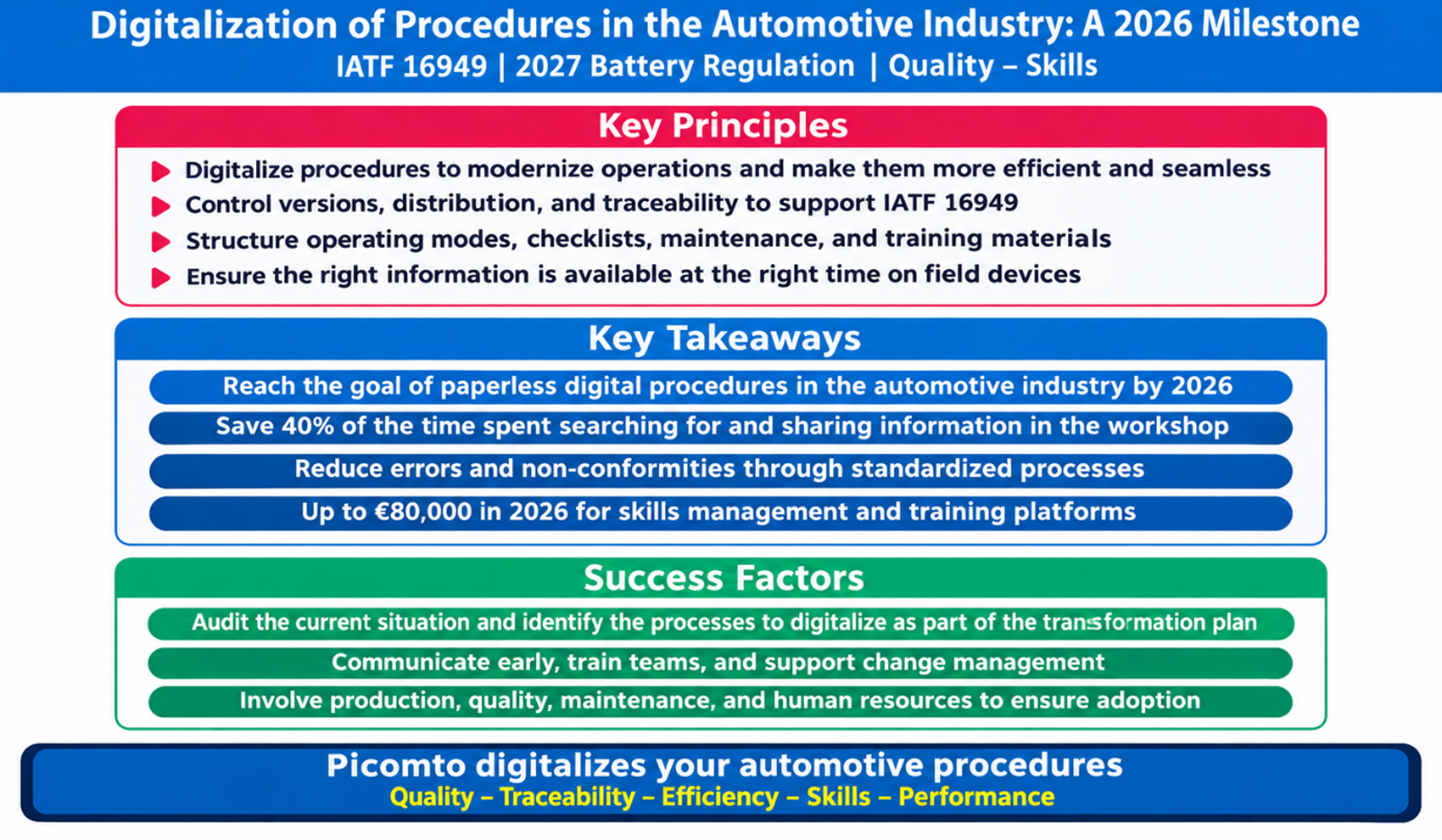
Key takeaways on the digitalization of procedures in the automotive industry:
- Digitalize the process, not just the document — Going digital does not simply mean converting a PDF. Information must be easy to update, distribute and use on the shop floor.
- Better-structured IATF 16949 compliance — Digital management makes it easier to control versions, keep documents available and maintain the traceability needed for audit preparation.
- Regulatory deadline approaching — As of October 30, 2026, the application of the battery passport on February 18, 2027 is now only a few months away.
- Significant HR challenge — The European Commission identifies workforce ageing and skills shortages as major challenges for the automotive industry.
- A gradual approach is recommended — Starting with a pilot workshop or process makes it possible to test usage, measure results and fix difficulties before full rollout.
- Accessibility across multiple devices — Making procedures available on equipment suited to the shop floor gives access to the right information at the point of execution.
CEO of Picomto (LinkedIn profile)
1. Why has the digitalization of procedures in the automotive industry become a strategic imperative?
Digital transformation in the automotive industry no longer concerns only connected vehicles, embedded software or fleet management. It now directly affects industrial operations: creating procedures, distributing instructions, collecting data and transferring knowledge.
Quality, methods engineering, maintenance and production managers have to handle more variants, more data and more documentation requirements. In this context, maintaining an exclusively paper-based system is becoming harder to sustain.
1.1. Which warning signs show that paper-based procedures are reaching their limits?
Vehicle electrification, rapid product evolution and OEM and supplier requirements are increasing the amount of information that must be controlled.
A modified paper procedure has to be reprinted, redistributed and replaced at every workstation concerned. This multiplies document management operations and increases the risk that an outdated version remains available.
The warning signs are generally easy to spot: obsolete procedures still present in the workshop, a great deal of time spent searching for information, re-entry of forms, difficulty knowing the latest revision, or a lack of visibility into how an instruction is actually applied.
In these situations, digitization alone is not enough. The goal is to organize a document flow that can genuinely be put to use.
1.2. What does digitalizing procedures in the automotive industry mean in practice?
The digitalization of procedures refers to the transformation of operating procedures, checklists, maintenance procedures and training materials into structured digital instructions.
These instructions can include text, photographs, videos, forms, checks or validation steps, and can be accessed from different devices depending on the industrial context.
The essential distinction is between digitization and digitalization. Scanning a paper procedure creates a digital file. Digitalizing a procedure also transforms how it is created, distributed and updated and, in some cases, how the information associated with its execution is collected.
1.3. Why is the automotive sector particularly affected by this transformation?
The automotive industry combines high-volume production, stringent quality requirements, a proliferation of part numbers, supplier management and demanding traceability requirements.
The shift toward electric, connected and software-defined vehicles adds further complexity. In its action plan published in 2025, the European Commission in fact places innovation and digitalization among the five priority areas for the competitiveness of the European automotive sector.
In this context, structured operational information available in the right place becomes a lever for reliability, training and continuous improvement.

2. What regulatory and normative framework applies to the digitalization of procedures in the automotive industry?
Compliance is a central element of the automotive sector. Two topics particularly concern information management: the quality requirements linked to IATF 16949 and the gradual move into a regulatory environment where product data is becoming more structured and digitally accessible.
2.1. What requirements does IATF 16949 impose on procedure management?
IATF 16949:2016 remains the reference quality standard for the organizations concerned in the automotive supply chain. The IATF still officially confirms the 2016 edition in its publications catalog.
This standard must be distinguished from the Rules for Achieving IATF Recognition – 6th Edition, which became applicable on January 1, 2025. These rules concern in particular the certification process and the bodies recognized by the IATF; they do not constitute a new edition of IATF 16949.
For companies, digital document management can make it easier to control versions, keep procedures available and retain information useful during audits. However, it does not by itself guarantee compliance: compliance also depends on the processes, responsibilities, controls and practices actually applied.
2.2. Does the digital battery passport accelerate the transition to digital procedures?
Yes, but the regulatory obligation must be distinguished from the means used to meet it.
Article 77 of Regulation (EU) 2023/1542 provides that, from February 18, 2027, every electric vehicle battery, every LMT (light means of transport) battery and certain industrial batteries of more than 2 kWh must have an electronic record known as a “battery passport.”
The regulation also sets out interoperability and access requirements for the information in the passport.
However, it does not explicitly require the use of digital checklists or digitalized procedures at every manufacturing workstation.
That said, this regulation reinforces the need to collect, structure, make available and trace battery-related data. A digital organization of production procedures and data can therefore ease this transition.

2.3. How does digitalization support proactive audit management?
A digital organization can make it possible to move from one-off document preparation to more continuous management of evidence and versions.
Revisions are logged with their history, documents can be distributed to the relevant users and field data is centralized. Quality teams thus find it easier to access the elements needed to verify what has been published, modified or filled in.
This approach also supports continuous improvement initiatives: information fed back from the field can be used to identify deviations, analyze root causes and update procedures.
3. What are the concrete benefits of a well-executed digitalization of procedures in the automotive industry?
The benefits depend on the process, the teams and the quality of the rollout. They should therefore not be presented as automatic.
The available studies nevertheless show that suitable digital instructions can improve execution quality and the learning of new tasks.
3.1. Does the digitalization of procedures really reduce operator errors?
A study by Letmathe and Rößler published in the Journal of Operations Management compared paper instructions with animated, interactive digital instructions in a controlled industrial setting.
In this experiment, participants using the digital instructions made fewer errors and completed tasks faster than the group using paper plans alone.
The study also shows that using paper and digital simultaneously brought no additional benefit compared with digital instructions alone, on the indicators studied.
These results support the case for digital instructions, but they come from a controlled experiment. They must therefore be tested against the actual conditions of each plant, the tasks concerned and the level of operator support.
3.2. How does digitalization speed up operational processes?
A digital procedure can be updated and then distributed without reprinting or physically redistributing binders.
Users thus access the version made available on authorized devices. This organization can reduce the time spent searching for information and simplify the replacement of obsolete versions.
Digital forms also limit some re-entry of data. Information collected during an operation can be centralized and used for quality monitoring, maintenance or continuous improvement.
Discover how Picomto structures the creation and sharing of digital operating procedures for production and methods teams.
3.3. Comparison table — Paper procedures vs. digitalized procedures
| Aspect / Indicator | Traditional method: paper | Digitalized method with Picomto |
|---|---|---|
| Procedure updates | Printing and redistribution required | Centralized updates and digital distribution |
| Shop-floor accessibility | Binder or physical document, with the risk of an outdated version | Access on smartphone, tablet or PC depending on authorized equipment |
| Revision traceability | Manual tracking, sometimes scattered | Version history and traceable actions |
| Field data collection | Paper forms and possible re-entry | Digital forms and data centralization |
| Analysis capability | Data harder to centralize and cross-reference | Data usable in dashboards and reports |
| Training time | Heavy reliance on the trainer and static materials | More self-directed learning paths thanks to multimedia and interactive content |
| IATF 16949 compliance | Documentary evidence harder to consolidate | Document management that facilitates the preparation of evidence |
4. How to implement the digitalization of procedures in an automotive company?
How do you implement digitalization in an automotive company? This question is at the heart of industrial decision-makers’ concerns. The answer comes down to three structuring steps, applicable regardless of the size of the site or the digital maturity of the organization.

4.1. Where to start: how do you audit the current situation and identify priorities?
The first step is to map the existing media: Word documents, PDFs, paper binders, checklists, shared files and local procedures.
Next, identify the processes where difficulties are most visible: frequent changes, errors linked to instructions, significant search time, re-entry of data or training difficulties.
Key performance indicators (KPIs) can be defined from the outset: training time, number of errors, usage rate, update time or number of obsolete versions detected.
A pilot on a single workshop, line or targeted procedure then makes it possible to evaluate actual use before extending the system.
4.2. Which criteria should guide the choice of a procedure digitalization solution?
The criteria must match the operational needs of the site:
- ease of creating and modifying instructions;
- accessibility on the devices used by operators;
- version and permissions management;
- collection and use of field data;
- operation adapted to the site’s connectivity constraints;
- integration with existing industrial systems;
- traceability and reporting.
For an automotive company, interoperability with an ERP, MES or CMMS is generally far more relevant than integration with a CRM geared toward customer relationship management.
Discover Picomto’s field data collection features to manage your quality and production indicators in real time.
4.3. How to manage change and ensure adoption by the teams?
Technology alone does not guarantee adoption.
An effective approach involves operators, front-line managers, quality teams and methods teams from the earliest phases. Users must be able to test the instructions and report what is missing, what slows down execution or what deserves to be simplified.
A progression of pilot → measurement → adjustment → rollout helps limit risk.
It is also important to measure results after deployment. If digital procedures are not consulted or if they complicate execution, the problem must be fixed before scaling up.
The best digital procedure remains the one that the operator can understand and apply simply under the real conditions of the workstation.
Conclusion
The digitalization of procedures in the automotive industry is not just one technology option among others. It is a structural response to regulatory and standards-related pressures (IATF 16949, the digital battery passport), to operational quality challenges and to the human challenge of passing on know-how in a sector undergoing profound change. Success rests on a methodical approach: auditing the current situation, choosing a suitable solution and managing change gradually. The benefits — reduced risk of errors, continuous compliance, capitalizing on expertise — are tangible in both the short and the long term, provided that paper is replaced rather than duplicated.
Would you like to digitalize your procedures and operating instructions? Discover how Picomto supports production, methods and quality teams in the automotive industry.
FAQ
What is the digitalization of procedures in the automotive industry?
The digitalization of procedures in the automotive industry consists of transforming operating procedures, checklists, maintenance instructions and training materials into structured digital content. It facilitates their updating and distribution, the collection of field information and the capitalization of know-how.
What is process digitalization?
Process digitalization consists of transforming a manual or document-based way of working into a structured digital flow. It goes beyond simple digitization: it changes the way information is created, distributed, entered, checked and analyzed.
What are the three pillars of digitalization?
Three main components can be distinguished: the digitization of information, connectivity that makes it possible to access content on appropriate devices, and the use of collected data to steer operations and continuous improvement.
What is the impact of digitalization on the automotive sector?
Digitalization can improve the availability of information, document traceability, training and data collection. It also supports a broader transformation of the automotive industry. The European Commission in fact regards digitalization, skills and the evolution of the workforce as strategic issues for the sector.
How do you implement digitalization in an automotive company?
The approach can be organized in three steps: auditing procedures and identifying priorities, selecting a solution suited to existing industrial systems, then running a pilot with field teams before measuring results and gradually extending the system.
What digital solutions exist for the automotive sector?
Companies can use document management systems, digital work instruction platforms, field data collection solutions, digital training tools and software connected to ERP, MES or CMMS systems. The choice depends on the process to be digitalized and the existing IT architecture.
Key points to remember:
- Digitalizing does not just mean digitizing — A digital procedure must make it easier to create, update, distribute and use information.
- IATF 16949 remains a central reference — Digital tools can facilitate document control, but they do not on their own guarantee compliance.
- February 18, 2027 is a concrete deadline — On that date, the European regulation requires the electronic passport for the categories of batteries concerned.
- Know-how must be structured and passed on — Workforce ageing and the need for new skills are explicitly identified by the European Commission as challenges for the automotive sector.
- Start small, measure, then expand — A targeted pilot confirms the usefulness of the solution under real conditions before larger-scale deployment.











Leave A Comment