
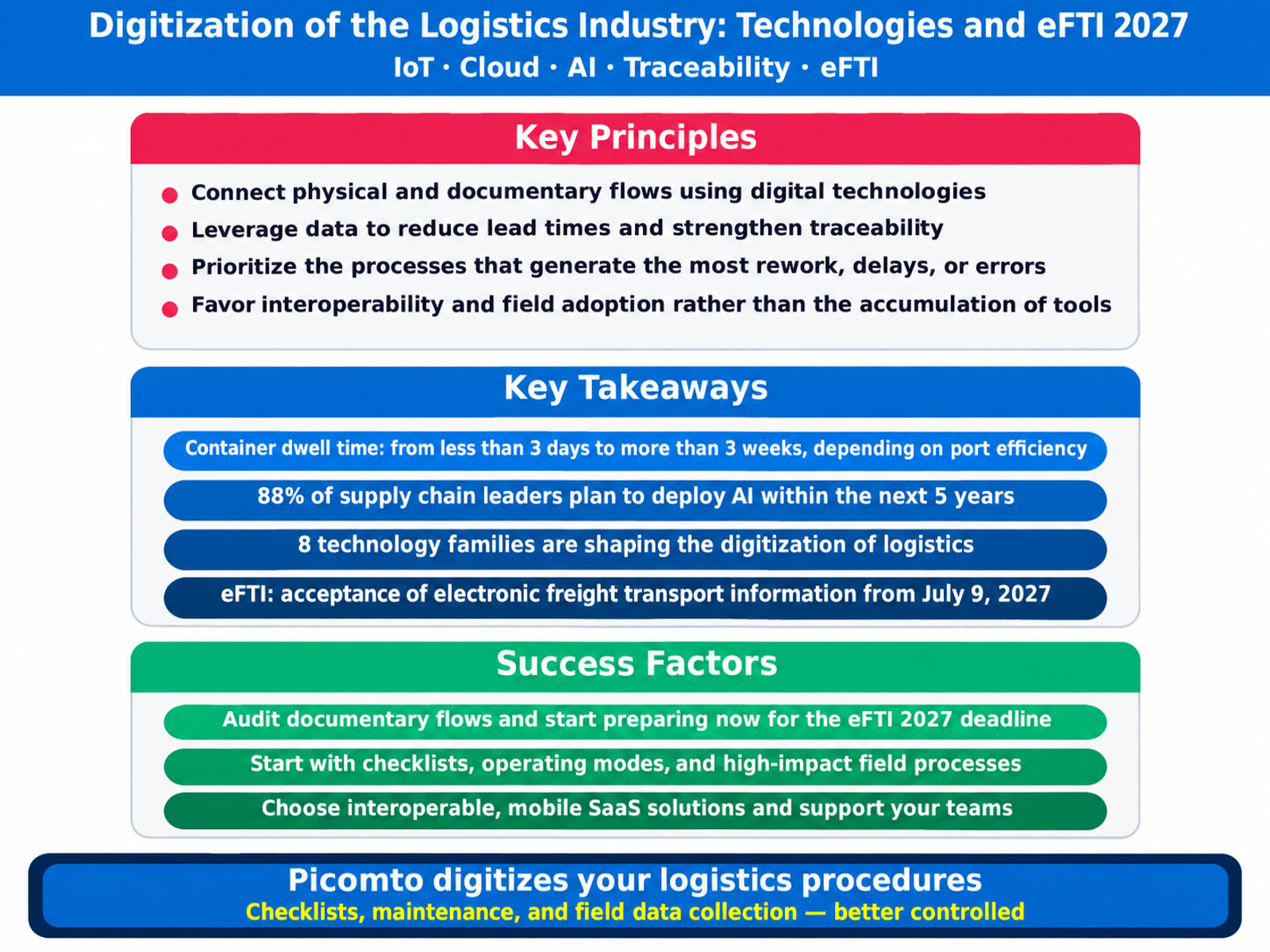
The digitalization of the logistics industry refers to the integration of digital technologies — IoT, cloud, artificial intelligence, digital twins — across all the physical and documentary flows of the supply chain. It delivers measurable effects: shorter lead times, better traceability, stronger compliance. Yet a persistent gap separates the most advanced players from the rest. According to the World Bank (Connecting to Compete 2025, April 2026), container dwell time ranges from under 3 days in the most efficient ports to more than 3 weeks in the least efficient. This gap illustrates concretely what digitalization can correct. This article covers the driving forces behind this transformation, the technologies that underpin it, the European and French regulatory framework, and its practical application to operational maintenance.
Would you like to understand how to structure your digitalization approach? Watch our 360° digitalization webinar!
What is the digitalization of the logistics industry?
The digitalization of the logistics industry consists in integrating digital tools (IoT, cloud, AI, blockchain) into the physical and documentary flows of the supply chain. It promotes traceability, shortens lead times and supports regulatory compliance. According to the World Bank (2026), performance gaps between ports confirm that data is now the main lever of logistics efficiency.
Key data — Digitalization of the logistics industry:
- Container dwell time ranges from under 3 days to more than 3 weeks depending on port efficiency. Source: World Bank, Connecting to Compete 2025 (April 2026)
- 88% of supply chain executives plan to deploy AI within five years; 56% are increasing their innovation spending. Source: MHI × Deloitte, 2026 MHI Annual Industry Report
- Logistics digitalization technologies fall into eight families: IoT, cloud, big data, cyber-physical systems, robotics, digital twins, augmented reality, blockchain. Source: Efthymiou & Ponis, Sustainability 13(21), 2021
- The eFTI Regulation requires Member State authorities to accept electronic freight transport information submitted via certified platforms from July 9, 2027. Source: European Commission
Key points to remember about the digitalization of the logistics industry:
- Data is the new logistics fuel. The performance gap between ports (3 days vs. 3 weeks) is largely explained by how well information flows are controlled.
- Eight technology families structure the transformation. IoT, cloud, big data, robotics, digital twins, augmented reality, blockchain and cyber-physical systems cover the entire chain.
- The eFTI Regulation takes effect in July 2027. Authorities will have to accept electronic freight transport information via certified platforms — a deadline to anticipate starting now.
- France published its roadmap in March 2026. It sets four objectives: digital sovereignty, interoperability, SME inclusion and data value creation.
- Intent is not enough. 88% of executives plan to deploy AI, but a significant gap persists between intent and actual execution (MHI/Deloitte, 2026).
- SMEs can get started without heavy infrastructure. SaaS solutions accessible on a smartphone or tablet allow a gradual entry into digital transformation.
Emmanuel Toulisse, CEO of Picomto (LinkedIn)
1. Why is digitalization now imperative in the logistics industry?
Digital transformation responds to several simultaneous pressures: global competition, the complexity of multimodal flows, regulatory requirements and customer expectations around visibility.
1.1. Which global pressures are accelerating the digital transformation of logistics?
International competition is intensifying on lead times and costs. Multimodal supply chains multiply friction points. Optimizing them becomes difficult without reliable, sufficiently up-to-date data.
The World Bank (Connecting to Compete 2025, 2026) introduces the Logistics Performance Indicators 2.0, built on objective data from the tracking of maritime, air and postal shipments. This new methodology replaces the historical approach based on perception surveys and makes it possible to measure the speed, reliability and connectivity of supply chains more directly.
This development confirms that logistics is increasingly data-driven. Players that do not produce, collect and exploit enough of their operational data have less visibility into inventory, lead times and logistics risks.
1.2. How are customer expectations and traceability redefining logistics standards?
Shipment tracking and access to reliable information have become standard expectations in B2B. Shippers want more visibility into lead times, exceptions and documentary compliance.
This trend pushes operators to digitalize their processes and centralize data from the different links of the supply chain. Consistent information across suppliers, carriers, warehouses and customers also limits manual re-entry and errors.
1.3. Why can logistics SMEs and mid-sized companies no longer stay on the sidelines of digitalization?
SMEs and mid-sized companies are also facing growing traceability and interoperability requirements. Exclusively paper-based processes become difficult to sustain when several players need quick access to the same information.
For a company looking concretely at how to digitalize a supply chain, the priority is not necessarily to replace its entire information system. It is more effective to identify the processes that generate the most re-entry, delays or errors, and then digitalize these friction points first.
SaaS solutions make it possible, for example, to start with checklists, work instructions or field data collection before gradually widening the approach.

2. What are the key technologies of industrial logistics digitalization?
The work of Efthymiou & Ponis (Sustainability, 2021) identifies several major Industry 4.0 technologies applied to logistics: IoT, cloud, big data, cyber-physical systems, robotics, AI, digital twins, immersive technologies and additive manufacturing.
2.1. IoT, cloud and big data: how do these technologies connect the supply chain?
IoT — sensors, RFID, geolocation — collects field data. The cloud makes it easier to centralize this data, while analytics tools make it possible to exploit it.
An RFID tag attached to a pallet can, for example, automatically update a WMS and help trigger replenishment. Data analysis can also help detect recurring delays or anomalies.
2.2. Digital twins, cyber-physical systems and robotics: what do they bring to industrial logistics?
| Technology | Main use case | Key advantage | Specific barriers |
|---|---|---|---|
| Digital twins | Warehouse flow simulation | Test scenarios without altering the real system | Modeling cost |
| Cyber-physical systems | Automated process control | Operational efficiency gains | System integration |
| Autonomous robotics | Order picking | Automation of repetitive tasks | Initial investment |
Digital twins make it possible to test scenarios before modifying a warehouse or a real flow. Robotics automates certain repetitive operations, and cyber-physical systems link equipment to digital systems.
2.3. Augmented reality, blockchain and AI: which emerging innovations for the supply chain?
Augmented reality guides operators in warehouses or during maintenance through instructions overlaid on their field of view. Blockchain for logistics secures document exchanges and supports the execution of smart contracts between partners. Artificial intelligence in logistics optimizes delivery routes and improves demand forecasting.
According to the MHI/Deloitte 2026 survey, 85% of executives expect to deploy cloud and 77% IoT and sensors within five years. Picomto is notably accessible on augmented reality glasses, which illustrates concretely how this technology is being integrated into logistics operating procedures.

3. What regulatory framework governs logistics digitalization in Europe and France?
Digital transformation also takes place within a regulatory framework that sets precise deadlines.
3.1. What is the eFTI Regulation?
The eFTI (electronic Freight Transport Information) Regulation governs electronic freight transport information in the European Union.
Key date: July 9, 2027. From that date, competent authorities will have to accept regulatory information transmitted electronically via certified eFTI platforms.
The regulation does not require companies to digitize all their documents. It mainly requires authorities to accept compliant electronic information when operators choose this method of transmission.
3.2. What is the French roadmap for logistics digitalization?
On March 31, 2026, the French government presented, at the 5th CILOG (Interministerial Logistics Committee), a policy orientation document devoted to logistics digitalization.
It sets four priorities: digital sovereignty and trust, interoperability, professional digital inclusion and data value creation. The digitalization of consignment notes is one of the priority projects.
3.3. How can you anticipate regulatory deadlines and secure documentary compliance?
A coherent approach rests on three steps: auditing existing documents, identifying the flows concerned, then choosing suitable solutions and training teams.
Digitalizing checklists, operating procedures and service reports also improves traceability and reduces the risks associated with outdated paper documents.
Discover how Picomto helps structure your digital checklists to support your documentary compliance efforts.
4. How does logistics digitalization apply in practice to maintenance and operational procedures?
Digitalization is also transforming maintenance, after-sales service and field procedures.

4.1. Why is digitalizing maintenance procedures a strategic lever for industrial logistics?
Paper procedures generate misinterpretation errors, delays and non-compliance risks. In heavily regulated sectors — pharmaceuticals, chemicals, aeronautics, energy — an outdated work instruction can lead to a line stoppage or a quality deviation.
Digitalizing operating procedures, checklists and service guides improves the reliability and traceability of operations.
Picomto makes it possible to create, standardize, share and analyze digital work instructions, accessible on smartphone, tablet, computer or augmented reality glasses.
4.2. Which concrete use cases illustrate the digitalization of logistics and after-sales service procedures?
Several scenarios illustrate the operational value of this approach. A maintenance technician follows a digital checklist on a tablet: each step is validated in real time, and deviations are flagged automatically. An operator collects field data via a mobile form — photos, measurements, observations — that feeds directly into an automatically generated service report.
An updated procedure is distributed instantly to all teams, with no printing or physical distribution. These uses promote workflow automation and reduce processing times.
4.3. How is remote expertise transforming interventions?
Remote maintenance reduces expert travel to remote or complex sites. A technician can call on a remote expert to validate an intervention or solve a problem without mobilizing any physical resource.
This approach supports service continuity and reduces the operating costs linked to travel. It is particularly relevant in the pharmaceutical, aeronautics and energy sectors, where intervention validation is subject to regulatory oversight.
Picomto Remote Expert directly addresses this need by enabling a remote expert call for complex tasks or validations without travel.
Conclusion
The digitalization of the logistics industry addresses challenges of competitiveness, traceability and compliance. IoT, cloud, AI, robotics and digital twins now cover a large part of the supply chain.
The eFTI deadline of July 9, 2027 and the French roadmap of March 2026 also give this transformation a concrete timetable.
To succeed, companies must avoid accumulating disconnected tools and prioritize high-impact processes, interoperability, data quality and adoption by field teams.
Would you like to digitalize your logistics and maintenance procedures? Request a Picomto demo and discover how to structure your digital work instructions, accessible on smartphone, tablet, computer or AR glasses.
FAQ
What is the digitalization of the logistics industry?
It refers to the integration of digital technologies into physical and documentary flows in order to improve traceability, visibility and operational efficiency.
What are the main digitalization tools in logistics?
The main tools are WMS, TMS, IoT platforms, cloud solutions, data analytics tools, digital twins and field data collection solutions.
What is the principle of digitization?
It consists in converting physical information, documents or processes into data that digital systems can use.
What are the steps in digitalizing a supply chain?
The approach generally rests on four steps: auditing the current situation, identifying priority flows, choosing suitable tools, then gradual deployment accompanied by team training.
Key points to remember:
- Anticipate the July 2027 eFTI deadline by auditing your documentary flows now.
- Start with operational procedures: digital checklists and operating procedures are the first actionable lever.
- Choose interoperable solutions that are accessible on mobile to encourage field adoption.









Leave A Comment