
Continuous improvement training for industrial companies is a strategic lever for boosting productivity, reducing breakdowns and building a culture of operational excellence. Yet many training programs remain disconnected from production realities. How do you turn acquired skills into measurable results on industrial lines? At its Pouso Alegre site in Brazil, Unilever recorded a 4% increase in OEE, a 42% reduction in breakdowns related to basic conditions and a 35% decrease in maintenance activities after three months of intensive technical training, according to McKinsey (2025).
Aimed at production, quality, methods and HR managers, this article details the benefits of training, the Lean, Kaizen and TWI methods, certifications, available funding and the role of digitalizing work instructions.
Do you want to see how digitalizing operating procedures concretely supports your Lean approach? Explore the Picomto features dedicated to shop-floor training!
What is continuous improvement training in industry?
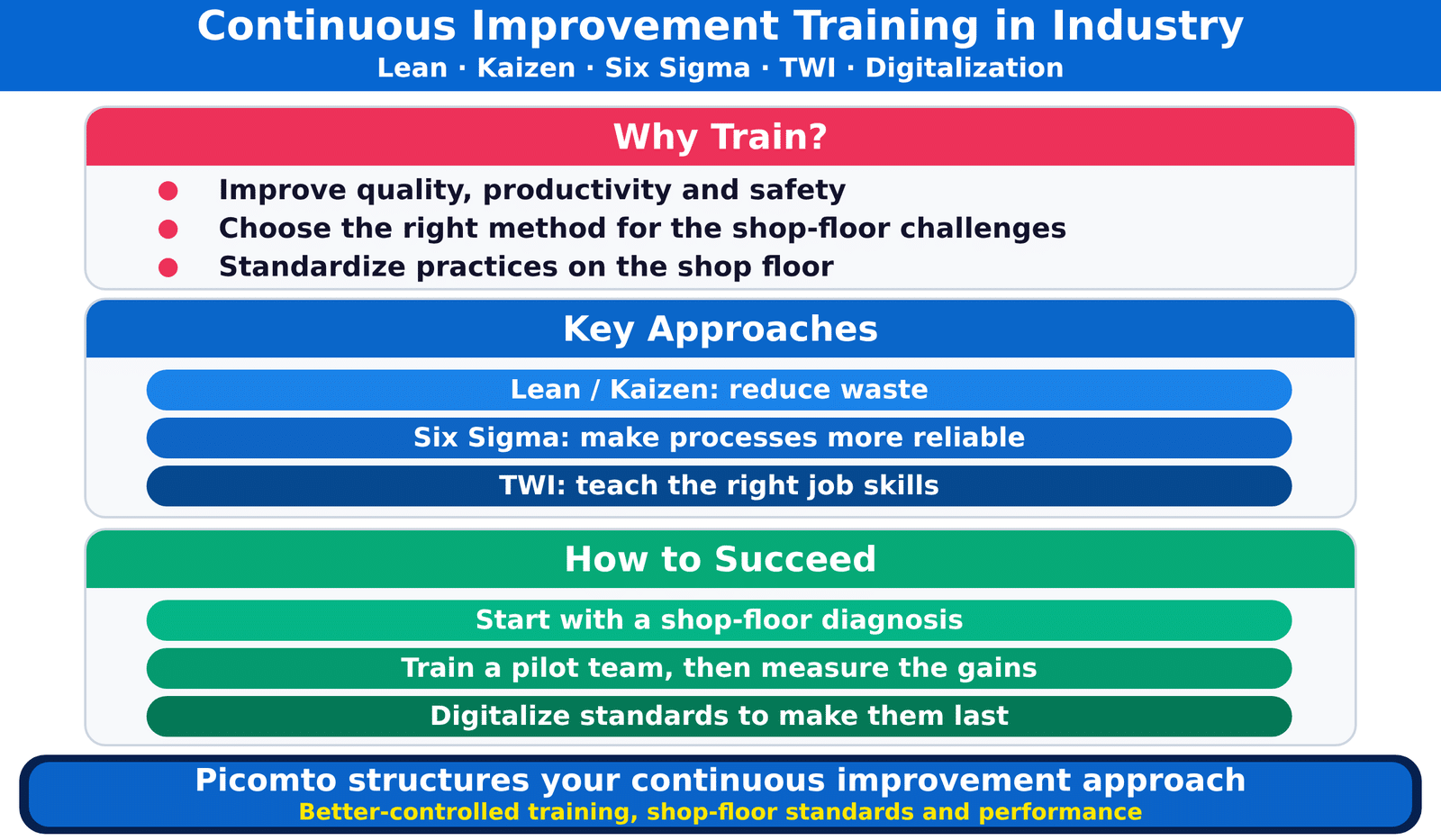
Continuous improvement training enables industrial companies to develop the skills needed to optimize their processes, limit waste and improve their performance on a lasting basis. It draws on methods such as Lean Manufacturing, Kaizen, Six Sigma or Training Within Industry (TWI). Its effectiveness is assessed notably through OEE (Overall Equipment Effectiveness), known in French as TRS (Taux de Rendement Synthétique), non-conformity rates, downtime and process stability. These methods rely on observation of the shop floor, standardization of practices and collective problem solving, in line with the principles presented by the Lean Enterprise Institute.
Key points to remember about continuous improvement training for industrial companies:
- +4% OEE, –42% breakdowns and –35% maintenance activities: results reported by McKinsey at Unilever’s Pouso Alegre site after three months of intensive training. These figures relate to a specific case and are not a performance guarantee.
- More than 25% fewer quality problems: result achieved by a European manufacturer after manager training sessions, according to McKinsey (2018).
- Lean, Kaizen, Six Sigma and TWI: complementary approaches to improve flows, solve problems and develop shop-floor skills.
- RNCP41137: the CQP Lean and Continuous Improvement Coordinator, at level 6, provides official recognition of professional skills in France.
- Funding: OPCOs (France’s sector-based skills operators) and certain public schemes can support industrial companies, subject to eligibility conditions.
- Digitalization: accessible, standardized and up-to-date work instructions facilitate the transfer of know-how and help sustain what has been learned.
CEO LinkedIn
1. Why is continuous improvement training vital for your industry?
Industrial companies must reconcile productivity, quality, cost control and regulatory requirements. Continuous improvement training provides concrete tools with measurable effects to address these challenges.
It concerns operators as much as technicians, methods managers and production managers.
1.1. What concrete gains can be expected in operational performance?
Structured training can help reduce production losses, improve team autonomy and develop their ability to solve problems.
The Unilever Pouso Alegre case illustrates this: after three months of intensive technical training, the site recorded +4% OEE, –42% breakdowns related to basic conditions and –35% maintenance activities, according to McKinsey.
These results do not necessarily correspond to a four-point increase in OEE. They must be interpreted in the context of the transformation carried out.
In practice, employees learn to analyze stoppages, identify recurring causes and implement corrective actions. Monitoring indicators gradually becomes a shared responsibility.
1.2. How does training affect quality and the reduction of non-conformities?
Appropriate training helps operators better understand quality standards and the consequences of production deviations.
Standardizing practices reduces differences in execution between teams. It also makes it easier to identify the causes of non-conformity.
In a study published in June 2018, McKinsey describes a European manufacturer whose managers led more than 50 improvement projects after their first training sessions, with a reduction of more than 25% in quality problems.
These results illustrate the value of combining training, shop-floor projects and operational management.
1.3. How does continuous improvement strengthen industrial competitiveness in the long term?
Beyond immediate gains, training helps develop a culture of problem solving and collective progress. It promotes skills transfer, operator involvement and process control. These practices can also facilitate the onboarding of new employees and support compliance with quality standards.
However, results depend on management commitment, team participation and follow-up of actions after training.
2. Which key methods should you use to train your teams in continuous improvement?

What continuous improvement training courses are available for industrial companies? The choice rests mainly on operational needs: Lean Manufacturing to optimize flows and reduce waste, Kaizen to develop incremental improvement, Six Sigma to control process variability and TWI to structure the transfer of know-how.
These approaches address different objectives and can be combined depending on the problems encountered, the skills available and the organization’s maturity.
2.1. Lean, Kaizen, Six Sigma: what are the differences and how are they used in industry?
| Method | Main objective | Associated tools | Preferred context |
|---|---|---|---|
| Lean Manufacturing | Reduce waste (Muda), unevenness (Mura) and overburden (Muri) | VSM, 5S, SMED, TPM | Production, logistics, flow optimization |
| Kaizen | Develop incremental improvement as close to the shop floor as possible | Kaizen events, PDCA, 5 Whys | All sectors and companies of all sizes |
| Six Sigma | Reduce process variability and defects | DMAIC, control charts, design of experiments | Pharmaceuticals, aerospace, chemicals, complex processes |
SMED aims to reduce changeover times, while 5S helps organize workstations. Value Stream Mapping (VSM) makes it possible to visualize flows and spot non-value-adding activities.
These tools are best taught using real production situations.
2.2. What is TWI (Training Within Industry) and why is it foundational?
Training Within Industry (TWI) is an American program developed during the Second World War to accelerate the training of industrial workers.
It is based notably on three modules:
- Job Instruction: effectively teaching job skills and work methods.
- Job Methods: analyzing and improving operating methods.
- Job Relations: developing working relationships and supervisory skills.
TWI later influenced Japanese industrial practices, notably at Toyota, as explained by the Lean Enterprise Institute. The Job Instruction module underscores the importance of documented standards and on-the-job training.
2.3. How do you choose the right method for your plant’s profile and challenges?
The choice of training depends on initial skills, the industrial sector and operational objectives.
An SME wishing to structure its first improvement projects could start with 5S and Kaizen. A company facing high process variability could favor Six Sigma.
| Profile | Suitable training | Main objective |
|---|---|---|
| Industrial operator | 5S, Kaizen, TWI | Standardize work practices and identify anomalies |
| Maintenance technician | TPM, 5 Whys | Reduce recurring breakdowns |
| Quality manager | PDCA, Six Sigma | Reduce non-conformities |
| Production manager | Lean Management, VSM | Improve flows and mobilize teams |
| Methods manager | SMED, VSM | Optimize changeovers and processes |
Tailored training that takes site constraints into account and includes hands-on exercises makes it easier to apply the methods day to day.
2.4. Which certifications validate continuous improvement skills?
Several certifications recognize the skills acquired through an industrial continuous improvement approach.
| Certification or pathway | Targeted skills | Recognition |
|---|---|---|
| CQP Lean and Continuous Improvement Coordinator | Process diagnosis, team coordination and management of improvements | RNCP41137 professional certification, level 6 |
| Lean Six Sigma Yellow Belt | Understanding of principles and participation in projects | Certification or certificate of attendance, depending on the provider |
| Lean Six Sigma Green Belt | Data analysis and management of improvement projects | Skills certification, depending on the certifying body |
| Lean Six Sigma Black Belt | Management of complex projects and mastery of statistical methods | Skills certification, depending on the certifying body |
| AFNOR Compétences training courses | Application of Lean and Six Sigma tools | Training that may prepare for a separate certification |
The CQP Lean and Continuous Improvement Coordinator (RNCP41137), sponsored notably by the UIMM (the French metalworking industries federation), is registered at level 6, with a registration expiry date of 18 July 2030. Yellow, Green and Black Belt certifications do not automatically correspond to titles listed in the RNCP, France’s national register of professional certifications. Their terms and recognition depend on the certifying body.
AFNOR Certification offers, notably, a Lean Six Sigma Green Belt certification, distinct from the preparatory training.
Before enrolling, check the prerequisites, the assessment methods, the recognition of the certificate and its fit with the employee’s duties.
3. How do you concretely launch and fund your continuous improvement approach?
An effective training approach starts with identifying operational needs. It then requires a deployment plan, tracking indicators and appropriate funding.
3.1. Where to start: what steps are needed to roll out continuous improvement training?
Deployment can follow five steps:
- Initial diagnosis: observe workstations, map flows and identify waste.
- Objective setting: select priority indicators, such as OEE, non-conformities or changeover times.
- Choice of methods and trainers: adapt content to operators, technicians and managers.
- Pilot deployment: train a first team and apply the methods on one production line.
- Scale-up: analyze the results, adjust standards and extend good practices.
Direct observation of the shop floor, known as Gemba, helps identify real problems before choosing training.
Success also depends on support after the sessions and on the availability of operational managers.
Find out how to digitalize your shop-floor training at the Picomto webinar: Digitalizing Training in Industry!
3.2. What funding schemes exist for industrial companies in France?
Several mechanisms can support training or continuous improvement projects, subject to the applicable criteria.
- Bpifrance Diag Carto-Flux: this industrial diagnostic scheme, presented by Bpifrance, aims to analyze production flows and define improvement actions. Its original terms mentioned a four-day diagnostic, invoiced at €4,400 excl. VAT, with 50% covered and a remaining cost of €2,200 excl. VAT. Its current availability and pricing must be confirmed with Bpifrance.
- OPCOs: skills operators can help fund training depending on the company’s size, its industry sector and the schemes available.
- Regional aid and industrial transformation programs: some measures can support projects that combine skills development and process modernization, subject to conditions.
Funding for training must be distinguished from funding for a diagnostic or an industrial investment. Each scheme has its own criteria.
3.3. How do you measure the return on investment of continuous improvement training?
Return on investment is measured by comparing performance before and after training, then assessing the gains genuinely attributable to the approach.
The main indicators are OEE, breakdown and non-conformity rates, changeover times and maintenance costs.
A baseline must be established before launch. Monitoring at 30, 60 and 90 days can then measure how practices and results evolve.
Digital collection of shop-floor data, photos and intervention reports makes it easier to document deviations. However, production variations and other actions undertaken at the same time must be taken into account.
4. Digitalizing work instructions: the invisible lever of continuous improvement
Lean or Kaizen training alone is not enough to guarantee lasting performance improvement. Skills must be applied regularly, assessed and built into production standards.
Digitalizing work instructions is a complementary lever to support this approach.
4.1. Why do paper work instructions hold back continuous improvement?
Paper media have several limitations: updates that are sometimes difficult, slow distribution of new versions, the risk of using an obsolete procedure and limited document traceability.
These difficulties can lead to lost time, errors and discrepancies between teams.
In the pharmaceutical, aerospace or chemical industries, the availability of validated procedures is a major issue for quality and operational control.
Digitalization facilitates document centralization and the distribution of updated versions. However, it replaces neither procedure validation, nor hands-on training, nor shop-floor checks.
4.2. How does Picomto concretely support the Lean approach by digitalizing operating procedures?
Picomto makes it possible to create, organize, distribute and consult digital work instructions on various devices, including smartphones, tablets and computers.
Operators thus have operating procedures, checklists and training materials accessible at the workstation.
This approach complements the principles of TWI Job Instruction: transmitting methods, making them easier to understand and maintaining shared standards.
Applications include production, quality, maintenance and the training of new hires.
Industrial feedback is also an important element. On its case study page, Picomto presents notably the initiatives of AgroMousquetaires to pass on know-how and train new employees, as well as those of Daher to improve the distribution of operating procedures and control their versions.
These examples illustrate concrete use cases without constituting a guarantee of identical results for every plant.
Do you want to discover real-world applications? Explore Picomto customer case studies to understand how manufacturers digitalize their work instructions and support their teams.
Shop-floor data collection and the tracking of deviations can also support the PDCA cycle by providing useful information for corrective actions.
Conclusion
Continuous improvement training for industrial companies is not a short-term expense. It is a structuring investment that can contribute to measurable gains in quality, productivity and breakdown reduction — provided it relies on proven methods (Lean, Kaizen, TWI), recognized certifications and tools suited to shop-floor reality.
The path is clear: diagnose needs, choose the appropriate methods, train management first, deploy gradually, then anchor what has been learned through digitalized, up-to-date work instructions. Digitalizing operating procedures is the link that turns educational gains into lasting operational reflexes.
Production managers, industrial directors, methods and quality managers: if you want to assess how Picomto can concretely support your continuous improvement approach, request a demonstration of our platform.
FAQ
What continuous improvement training courses exist?
The main continuous improvement courses cover Lean Manufacturing, Kaizen, Six Sigma, TWI and problem-solving tools. They can take the form of short awareness sessions, hands-on programs or courses preparing for a professional certification. The choice depends on the objectives and the profiles concerned.
What is the difference between Lean Manufacturing and Six Sigma?
Lean Manufacturing mainly aims to improve flows and reduce waste, whereas Six Sigma seeks to control process variability and reduce defects. These methods are complementary and can be combined in a Lean Six Sigma approach.
What are the four steps of continuous improvement?
The four steps correspond to the PDCA cycle: Plan, Do (deploy), Check and Act (adjust). This method consists of identifying a problem, testing a solution, measuring the results, then standardizing or correcting the actions taken before starting the cycle again.
Which certifications can you obtain in industrial continuous improvement?
Certifications include notably the CQP Lean and Continuous Improvement Coordinator (RNCP41137) and the Lean Six Sigma Yellow, Green or Black Belt certifications. Their scope differs depending on the certifying body. Completing a training course does not automatically guarantee obtaining a certification.
How do you sustain the benefits of Lean training on the shop floor?
Sustaining them requires hands-on exercises, management coaching, workstation observations and regular monitoring of indicators. Standardized, up-to-date work instructions help teams apply the methods taught and maintain good practices.
Key takeaways
- Train management first: trained managers lead more projects and bring their teams along in continuous improvement.
- Choose the method according to your maturity: Kaizen and 5S to get started, Six Sigma for complex processes, TWI to standardize the transfer of know-how.
- Define a baseline before training: without starting indicators (OEE, breakdown rate, non-conformities), the ROI of training remains invisible.
- Tap the available funding: the Bpifrance Diag Carto-Flux and the OPCOs significantly lower the entry cost of the approach (France only).
- Digitalize work instructions: this is the condition for training gains to turn into lasting, traceable shop-floor practices.











Leave A Comment