
A mobile tablet solution for aviation maintenance is a SaaS tool that enables technicians to access, execute, and trace maintenance procedures from a mobile device — in connected or offline environments — in alignment with the sector’s regulatory requirements. Yet many field teams still rely on paper folders, undated printouts, and handwritten checklists. This gap between compliance requirements and operational reality creates concrete risks: data entry errors, obsolete procedures, incomplete traceability, and time lost during audits. What solutions are available for aviation maintenance on a tablet or mobile device? This article answers that question in four parts: why digitalisation is becoming imperative, how this type of solution works, the tangible benefits it delivers for field teams, and how to properly select and deploy the right tool for your organisation.
Eliminate data entry errors and make your field interventions more reliable: request your personalised Picomto demo!
| What Is a Mobile Maintenance Solution? |
|---|
| A mobile tablet solution for aviation maintenance helps technicians execute the right procedures, collect field evidence, and generate reliable records. It does not automatically guarantee compliance, but it supports traceability, auditability, and document control. |
Key Takeaways on Mobile Tablet Solutions for Aviation Maintenance :
- Digitalisation is becoming a major lever for making interventions more reliable, reducing errors, and improving the restitution of field evidence.
- Offline mode is a non-negotiable criterion: hangar, workshop, and flight line environments do not always have stable network connectivity.
- Digital work instructions reduce the risk of errors through step-by-step guidance, mandatory sign-offs, and visual aids.
- Integration with CMMS or ERP systems determines effectiveness: an isolated solution creates data silos that are detrimental to digital workflow management.
- Compliance depends on reliable, dated, accessible, and auditable records: intervention logs, electronic signatures, reports, and task history.
- Skills development is accelerated through visual work instructions available on tablet, beneficial for both onboarding and complex interventions.
Emmanuel Toulisse, CEO of Picomto — LinkedIn
1. Why Must Aviation Maintenance Digitalise?
Aviation maintenance operates in one of the most constrained industrial environments in existence. Every intervention engages aircraft safety, technician liability, and compliance with applicable regulatory frameworks.
In this context, traditional methods are reaching their structural limits. Digitalisation is not a response to a mere technological trend: it responds to an operational requirement for reliability, traceability, and document control.
1.1. What Are the Concrete Limitations of Paper-Based Methods in Aviation Maintenance?
Paper-based processes generate several dysfunctions in heavily regulated industrial organisations.
- First limitation: updates. A printed document becomes obsolete as soon as a procedural revision occurs. A technician may unknowingly work from an outdated version.
- Second limitation: traceability. A manually signed paper form does not always allow the precise reconstruction of an intervention’s sequence: validated step, time, operator, collected data, or observed anomaly.
- Third limitation: data entry. Handwritten data requires computer transcription. Each manual transfer introduces an additional risk of error.
- Fourth limitation: accessibility. Locating the correct procedure in a multi-volume binder slows technicians’ work and undermines team performance.
Solutions such as Picomto make it possible to replace these paper instructions with digital work instructions accessible on tablet — always up to date, consultable offline, and automatically traceable.
1.2. What Safety and Compliance Requirements Are Placed on Maintenance Teams?
The aviation sector is subject to stringent regulatory frameworks. In Europe, EASA regulations on continuing airworthiness — notably Part-M and Part-145 — govern organisations, records, responsibilities, and maintenance documentation.
The IAQG AS9100 standard, used across the aviation, space, and defence sectors, also reinforces requirements for document control, quality management, and process traceability.
Electronic signatures, electronic records, and electronic manuals are also addressed by FAA AC 120-78B, which serves as a useful reference for environments using digital documentation.
In this context, compliance is not a competitive advantage: it is an absolute prerequisite. A mobile tablet solution for aviation maintenance helps to structure this documentation natively, with traceability, historisation, and auditability logic built in from the outset.
Given these constraints, the question is no longer whether aviation maintenance must digitalise, but how a mobile tablet solution concretises this transformation on a day-to-day basis.
2. How Does a Mobile Tablet Solution for Aviation Maintenance Work?
A mobile aviation maintenance solution is built on a clear architecture: procedure creation in back-office, deployment to technicians’ devices, guided execution in the field, data collection, and synchronisation.
This cycle incorporates several distinctive features that differentiate it from a simple document tool or a PDF library.
2.1. How Are Digital Work Instructions Created and Used on Tablet?
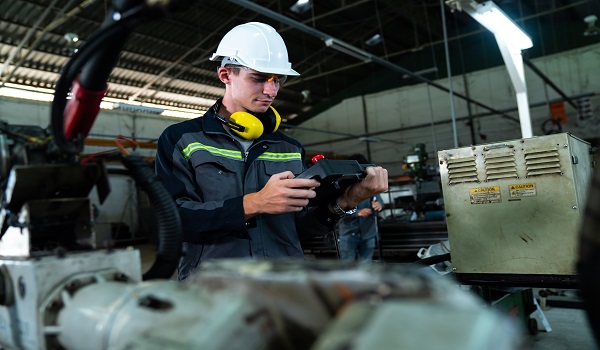
Procedure creation takes place via a web interface. The author — a methods engineer, quality manager, or maintenance supervisor — structures the intervention into sequenced steps. They incorporate visual aids, photographs, diagrams, videos, conditional alerts, and mandatory validation checkpoints.
Once approved, the procedure is published and made accessible on the tablets or smartphones of field technicians. The underlying logic is the right action, at the right time, by the right person. In the event of a revision, the update is deployed centrally. Every technician therefore works with the current version at all times.
Offline access is ensured through prior synchronisation. The technician executes the procedure step by step, validates each stage, and records collected data directly on their tablet — even without an active network connection.
2.2. What Features Are Essential in an Aviation Maintenance Application?
Not all mobile maintenance solutions are equal. In an aviation environment, the value of a mobile MRO software package depends on its ability to guide technicians, operate offline, trace interventions, and integrate with existing systems. The following features determine the genuine operational value of a tool in an aviation environment:
| Feature | Field Utility | Criticality |
|---|---|---|
| Interactive electronic checklists | Step-by-step guidance, mandatory sign-off | High |
| Offline mode with synchronisation | Working in hangar or on flight line without network | Indispensable |
| Automatic time-stamped log | Intervention traceability for audit | High |
| Automatic time-stamped log | Intervention traceability for audit | High |
| Automatic time-stamped log | Regulatory compliance of records | Indispensable |
| Integrated visual support: video, diagram | Regulatory compliance of records | Important |
| Barcode scanning for parts management | Rapid identification, error reduction | Important |
Picomto integrates all of these features, including field data collection, on-site photography, and automatic generation of intervention reports.
For complex tasks requiring remote expertise, the Picomto Remote Expert feature enables a technician to call a remote expert in real time — with no physical travel and no loss of time.
2.3. How Does a Tablet Solution Integrate with Existing Systems Such as CMMS or ERP?
Interoperability is often the primary point of friction during a deployment. An integrated mobile MRO application must be able to communicate with existing information systems: CMMS, ERP, PLM, document repository, or quality management tool.
Integrations typically rely on RESTful APIs, native connectors, or structured data exports. The capacity for data exchange between the mobile solution and the central management system eliminates duplicate data entry and maintains data consistency.
The BYOD (Bring Your Own Device) model, where permitted by the organisation, allows the solution to be deployed on equipment already in use: tablets, smartphones, computers, or augmented reality glasses. Picomto is a SaaS platform accessible across all of these devices, with no heavy infrastructure installation required. This flexibility facilitates adoption and reduces implementation lead times.
These features are only useful to the extent that they generate measurable benefits for field teams.
3. What Are the Tangible Benefits for Aviation Maintenance Teams?
The value of a mobile tablet maintenance solution is measured on the shop floor, not in the specifications. Benefits are organised around three axes: operational performance, documentary compliance, and technician skills development.
3.1. What Time and Reliability Gains Are Observed in the Field?
The first gain is a reduction in document search time. A technician who instantly accesses the correct procedure on their tablet — without consulting a binder or calling a subject matter expert — recovers direct operational time.
The second gain is a reduction in execution errors. Step-by-step guidance with a mandatory sign-off at each stage functions as a digital Poka-Yoke: it helps to maintain execution control by making step omission or skipping more difficult.
The digitisation of work processes also eliminates back-and-forth between the workstation and the office. Aviation maintenance efficiency is further improved through barcode scanning, parts management, and ERP or CMMS integration.
3.2. How Does the Solution Improve Intervention Traceability and Auditability?
Every action performed via a digital maintenance solution generates an automatic record: timestamp, technician ID, validated steps, collected data, photographs taken, and associated comments.
These logs form the basis of digital compliance audits. The integrated electronic signature replaces the handwritten signature with a secure, named, dated, and historised validation. It must, however, be used within a framework that complies with internal procedures and applicable requirements.
Digital document reviews and examination of work history become accessible more rapidly. Picomto automatically generates intervention reports from field-collected data. This capability benefits maintenance teams, but also Quality and Methods departments.
3.3. What Is the Impact on Technician Training and Skills Development?
Illustrated digital work instructions accelerate the onboarding of new technicians. An operator in the onboarding phase immediately has access to up-to-date procedures, enriched with visual aids and key attention points.
The Picomto Remote Expert feature reinforces this dynamic. A less experienced technician can call on a remote expert for real-time validation or guidance. This collaborative environment fosters knowledge transfer while preserving expert availability.
All of this, of course, depends on selecting the right solution for your operational constraints and achieving a successful deployment.
4. How to Select and Deploy a Mobile Tablet Solution for Aviation Maintenance?
The selection of a solution must not be based solely on the announced feature set. It must take into account the specific constraints of your organisation: existing equipment fleet, information systems in place, the team’s digital maturity level, cybersecurity requirements, and the regulatory requirements specific to your activity.

The following are the priority criteria to evaluate during selection:
- Offline compatibility — does the solution operate fully without a permanent network connection?
- Technician ergonomics — is the interface intuitive under field conditions?
- Integration capabilities — available APIs, documented CMMS/ERP connectors, exploitable export formats.
- Data security — hosting, access rights management, authentication, GDPR compliance.
- Traceability — are logs, signatures, photographs, histories, and reports viewable and exportable?
- Deployment support — initial training, ongoing support, change management.
- Trust signals — certifications, security page, customer references and logos only where verified and authorised.
A successful deployment generally follows a phased approach: pilot on a limited scope, measurement of results, adjustment, then progressive roll-out. The solution must be perceived as an execution aid, not as an additional oversight tool.
Conclusion
The digitalisation of aviation maintenance is not a matter of organisational comfort. It responds to the regulatory, operational, and safety requirements specific to one of the most constrained industrial sectors in existence. A mobile tablet solution for aviation maintenance helps to structure procedures, make their execution more reliable, trace every intervention, and facilitate audits.
The four dimensions covered in this article form a logical continuum: understanding why digitalisation is imperative, identifying how a solution works in practice, measuring field-level benefits, and then selecting and deploying the right tool for the organisation.
The mobile tablet is only the first milestone. It opens the way to a broader digital value chain: connected CMMS, AI-assisted predictive maintenance, augmented reality for complex interventions. The digital transformation of aviation is built step by step — and every step begins with field data.
Evaluate the integration of Picomto into your MRO, CMMS, or ERP environment: request a personalised demonstration tailored to your current processes.
FAQ
What is the best aviation maintenance software?
There is no universally “best” solution: the choice depends on your existing systems, regulatory requirements, and digital maturity level. Picomto is a SaaS platform adapted to regulated industrial environments, covering the creation, execution, and traceability of maintenance procedures on tablet or mobile.
What is aviation maintenance?
Aviation maintenance refers to the full range of inspection, repair, and overhaul operations performed on an aircraft to maintain its airworthiness. It is governed by stringent regulatory frameworks (EASA in Europe) and must be fully documented and traceable.
What are the two types of aviation maintenance?
Aviation maintenance is divided into preventive maintenance — carried out at planned intervals to anticipate failures — and corrective maintenance, triggered following the detection of an anomaly or malfunction. Both types require rigorous documentation and complete intervention traceability.
What are the 5 pillars of aviation maintenance?
The fundamental pillars of aviation maintenance are generally: airworthiness, technical documentation, intervention traceability, personnel qualification, and parts management. These pillars structure the regulatory requirements of competent authorities such as EASA.
What are the responsibilities of aviation maintenance management?
Aviation maintenance management aims to schedule interventions, manage human and material resources, ensure documentary compliance, track aircraft history, and produce records during regulatory audits. It involves coordination between field teams, methods departments, and quality services.
Summary
- A mobile tablet maintenance solution helps to better control traceability and supports compliance with applicable aviation regulatory frameworks.
- Offline mode is not an option: it is an operational prerequisite for any deployment in a hangar or on the flight line.
- Integration with existing systems (CMMS, ERP) determines the real value of the solution — evaluate available APIs before making any decision.
- The benefits extend beyond maintenance alone: quality, methods, and training departments also benefit from digital work instructions.
- Deploy in phases: a targeted pilot enables real results to be measured before rolling out the solution across the entire organisation.











Leave A Comment